
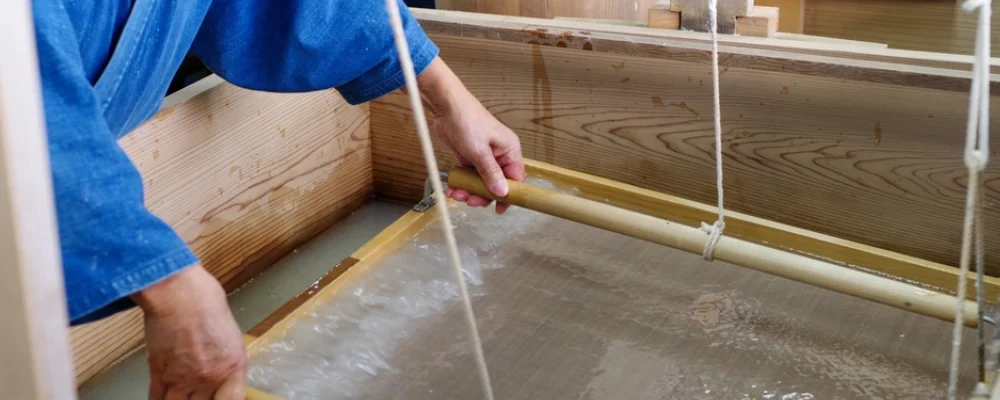
Washi is traditional handmade Japanese paper, made from inner bark fibres of native shrubs such as kozo (paper mulberry). Washing is revered for its strength, flexibility and translucency, and is used in everyday items like shoji screens, lanterns, folding fans and umbrellas.
Washi is different from the paper we use today. Most modern paper is machine-made from short wood-pulp fibres, bleached and chemically treated so it can be produced quickly and cheaply. They also tend to yellow and turn brittle within decades.
Washi, on the other hand, is made by traditional methods, cooked in a mild alkaline solution rather than harsh bleach, leaving it neutral to alkaline and low in impurities. This means washi resists decay for centuries rather than decades.
A brief history of washi
Papermaking is thought to have reached Japan from the Asian continent around the seventh century, putting washi’s documented history at at least 1,300 years. During the Edo period (1603-1868), washi’s strength and absorbency made it central to daily life, from shoji doors to the paper that carried ukiyo-e woodblock prints. Industrialisation later led to the decline of the industry, where it is said more than 100,000 papermaking families in the late 1800s had shrunk to a few hundreds by 2008.
UNESCO recognises four regional washi traditions, Sekishu-banshi, Hon-minoshi, Hosokawa-shi and Echizen Torinoko-gami under its Representative List of the Intangible Cultural Heritage of Humanity.
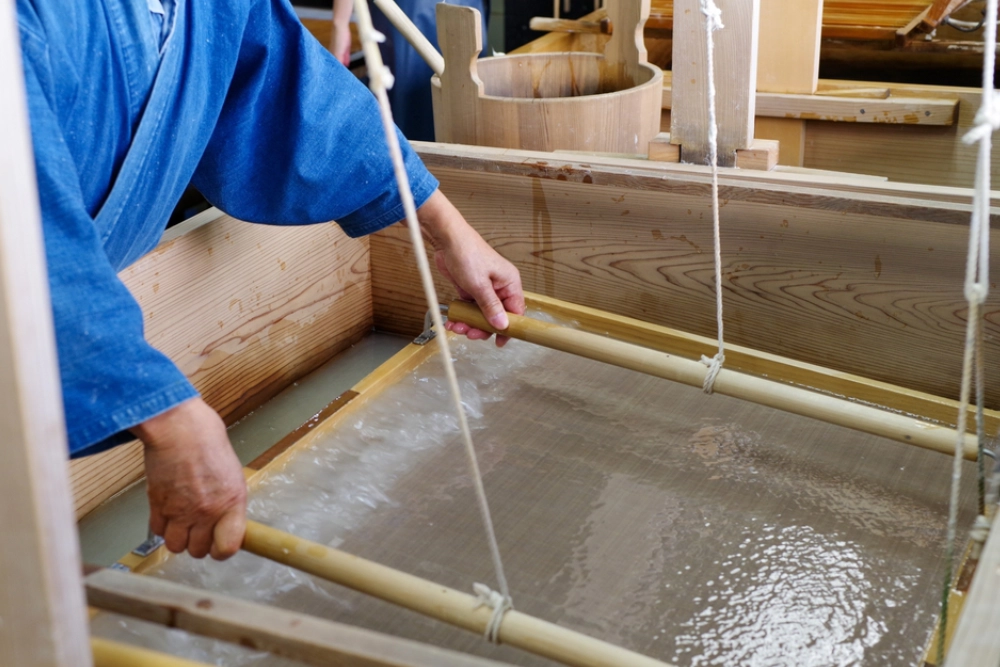
Washi as a model of sustainable material
It is not an exaggeration to think washi as a herald of sustainability.
The materials used, like kozo and mitsumata, are grown as farm crops that resprout from the same rootstock each year. This allows us to harvest their branches annually damaging the environment, a huge contrast to today’s paper supply, which still depends on trees that take decades to regrow.
The production method is also kind to the environment. Traditional washi making avoids doesn’t need harsh chemicals, relying instead on mild alkaline cooking. Traditional wisdom also shines here, like how in snowy regions, sunlight reflected off snow are used to whiten fibres naturally.
Last but not least, washi resists decay for centuries, so less of it needs to be replaced and thrown away in the first place. Properly made washi can resist tear, too (and we do mean that you’ll find it hard tear it through brute force!)
Modern innovations of washi
Precisely because of how attractive washi is as a sustainable material, there are efforts not only to revive the declining industry, but also innovate through it.
For example, paper product company PEPAL Inc. has turned unwanted rice into “kome-kami” (rice paper), upcycling food waste into a new paper material, while retaining the sustainable traditional production of washi.
Another example sees washi being used in fashion, with circular fashion brand “aloof” home making 100% biodegradable clothing from washi fibre blended with silk and cotton. It even runs a take-back scheme in which worn garments are shredded and composted at the brand’s own farm in Nantan City to grow vegetables that are sold back to customers.
Glossary List
0~9
A
B
C
- Carbon Offset
- Circular Economy
- Circular Economy Commerce
- Circular Edonomy
- Closed-loop system
- Cradle to Cradle
D
E
F
- Fair trade
- J-Credit Scheme
- Food waste
- Forest bathing (Shinrin-yoku)
- FSC Certificate
- Furoshiki
- FutureCity initiative
G
H
I
J
K
L
M
O
P
R
S
- Sanpo Yoshi
- Satoumi
- Satoyama
- Satoyama Initiative
- SDGs (Sustainable Development Goals)
- SDG Compass
- SDG Future City
- SDG Global Indicators
- Sharing Economy
- Shimatsu no kokoro
- Shinto
- Shojin Ryori
- Shokunin
- Shokuyojo
- Society 5.0
- Sushi
- Sustainable Aviation Fuel