
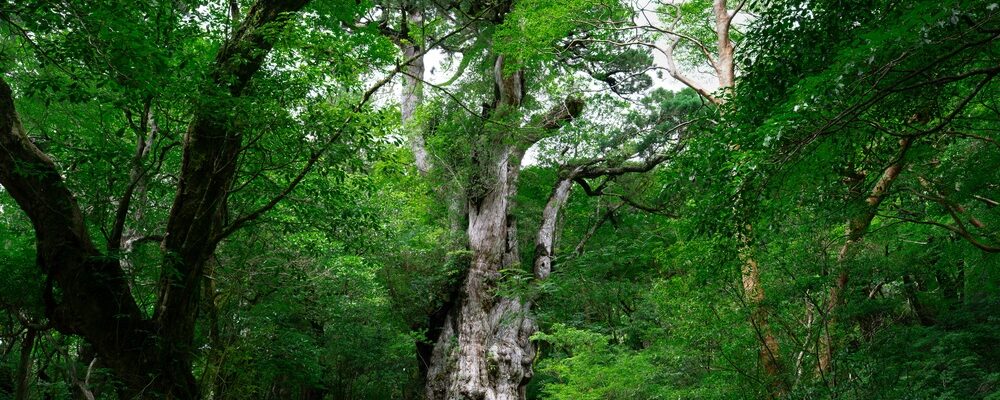
Ikei no nen (Japanese kanji 畏敬の念) is the Japanese term for a feeling of reverence and awe when we stand before something far greater than ourselves. It is not a simple sentiment to grasp as it is profoundly a mix of humility, wonder and respect at the same time, nor it is used as often in conversations. However, ikei no nen runs through Japanese religious life, aesthetics, education and, increasingly, the modern science of wellbeing.
Since 2008, Japan’s Ministry of Education, Culture, Sports, Science and Technology (MEXT) uses the phrase “seimei ni taisuru ikei no nen” in encouragement to foster reverence for life. It can be found in the official Courses of Study that guide moral education in every elementary and junior high school. The ministry’s own English-language translation states that it aims to cultivate “a spirit of respect for human dignity and reverence for life” in their daily lives, and even the idea of “beautiful things” to encompass the wonder and mystery of the natural world itself.
Ikei no nen is most visible in Shinto and in human’s relationship with nature. Many shinto shrines are wrapped in a chinju no mori, a sacred forest believed to be the dwelling place of a kami, or deity, with ancient trees marked by shimenawa ropes and revered as living gods in their own right. In the older, animist form of the tradition known as Koshinto, reverence extends to mountains, rocks, rivers and waterfalls themselves (even some with no shrine at all). This cultivates a instinct for coexisting with nature rather than mastering it.
We can see this sentiment alive in modern Japan. Ise Jingu is considered Shinto’s most sacred site. Roughly every twenty years, the entire shrine complex is dismantled and rebuilt from scratch on an adjacent plot, a ritual called Shikinen Sengu that has continued for over 1,000 years. The timber is drawn from a forest cultivated specifically for the purpose since the 1920s, which supporters describe as one of the world’s oldest sustainability schemes, a way of renewing tradition while continuing to honour the forest it depends on.
Another example is Yakushima island, where hikers travel eight to ten hours through mossy forest to reach Jomon Sugi, a cedar estimated at somewhere between 2,000 and 7,200 years old, and many describe the encounter less as sightseeing than as an experience of humility before something impossibly old.
Ikei no nen sits alongside concepts like mottainai and satoyama as part of sustainable Japanese mindsets that have kept Japan’s relationship with nature a reciprocal one.
Glossary List
0~9
A
B
C
- Carbon Offset
- Circular Economy
- Circular Economy Commerce
- Circular Edonomy
- Closed-loop system
- Cradle to Cradle
D
E
F
- Fair trade
- J-Credit Scheme
- Food waste
- Forest bathing (Shinrin-yoku)
- FSC Certificate
- Furoshiki
- FutureCity initiative
G
H
I
J
K
L
M
O
P
R
S
- Sanpo Yoshi
- Satoumi
- Satoyama
- Satoyama Initiative
- SDGs (Sustainable Development Goals)
- SDG Compass
- SDG Future City
- SDG Global Indicators
- Sharing Economy
- Shimatsu no kokoro
- Shinto
- Shojin Ryori
- Shokunin
- Shokuyojo
- Society 5.0
- Sushi
- Sustainable Aviation Fuel