
Imagine buying a new smartphone, and you put away your old one in a drawer. Now imagine 130 million Japanese people doing the same. That is a whole lot of rare metals tucked away, including gold, silver, and copper. This is an “urban mine” that Japan wants to tap into for their circular economy vision, and the nation eyes urban mining for most electronics, from toasters to personal computers.
What is urban mining?
Urban mining is the practice of recovering valuable raw materials from discarded products and waste streams, as opposed to extracting them from the earth. Conventional mining digs into geological deposits, while urban mining digs into what we have already used, and, in a mottanai sense, thrown away.
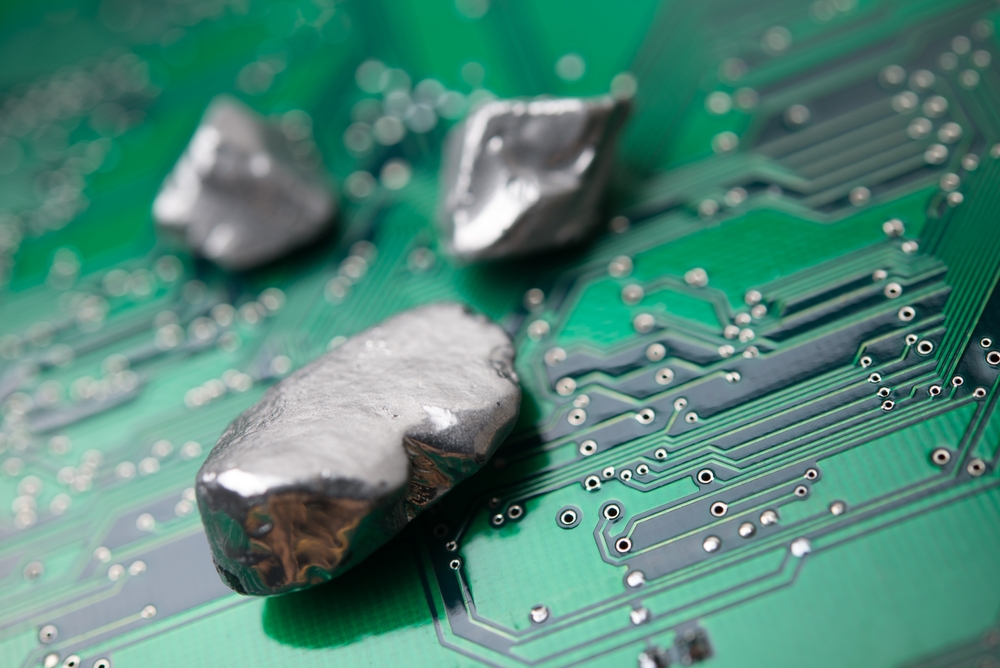
The strongest focus is on electronic waste, or e-waste: smartphones, laptops, televisions, washing machines, and batteries. These are what we discard when we buy something newer. These devices can have a high concentration of rare material. A circuit board contains gold, silver, copper, palladium, and a collection of rare-earth and critical minerals (like neodymium, cobalt, lithium, and indium). These materials are essential to modern manufacturing.
Urban mining allows us to recover these materials from our used electronics. With circular economy, we can even build supply from the waste our own society generates.
The term “urban mining” is Japanese in origin. Toshi kozan, literally “urban mine”, treats the metal already embedded in a society’s products as an orebody to be worked rather than waste to be managed, whether they are in use, in storage, or heading for disposal. Its systematic formulation is credited to Professor Michio Nanjō and colleagues at Tohoku University’s Research Institute of Mineral Dressing and Metallurgy, whose 1988 paper placed recycling within what he called a comprehensive view of resources. The phrase had surfaced slightly earlier: in 1981, Hiroshi Kitahara and Masao Koga published an article on the gold accumulating at Haneda Airport announcing that the age of the urban mine had arrived, though their subject was confined to aircraft.
Japan has few metal deposits worth working at today’s prices, but decades of electronics and appliance manufacturing have left an enormous quantity of metal above ground. In January 2008, the National Institute for Materials Science put figures on that stock: roughly 6,800 tonnes of gold, equivalent to around 16% of world reserves then estimated at 42,000 tonnes, and some 60,000 tonnes of silver, about 22%, with indium, tin and tantalum each accounting for more than a tenth of global reserves. On those numbers, Japan’s urban mine rivals the endowment of a major resource nation.
Problems with e-waste
What are some problems if we do not deal with e-waste?
In 2022, the world generated a record 62 million tonnes of e-waste. That is roughly the weight of 1.55 million fully loaded 40-tonne trucks, parked bumper to bumper all the way around the equator. Annual generation is rising by 2.6 million tonnes each year, putting the world on course for 82 million tonnes by 2030, which is a 33% increase. However, only 22.3% was properly collected and recycled. The rest was landfilled, incinerated, informally processed, or simply hoarded.
Consequences come in many forms, and the most common problem is pollution and the effect on health. Some materials in e-waste are hazardous if mishandled, like lead, mercury, cadmium, and chromium. When devices are broken and crushed in landfills, these chemicals leach into soil and water and disperse through the air. The World Health Organization links informal e-waste recycling to reduced lung function, neurological damage, and harm to foetal development.
When we view these sources as urbaning mining resources, we also regret the gargantuan resource loss. Furthermore, more mining for new virgin resources will mean more deforestation, habitat destruction, water contamination, and greenhouse-gas emissions.
What has been on Japan’s minds is its dependency on imported raw materials, which is highly affected by geopolitics, trade restrictions, or natural disasters. Tightening supply chains would impact electronics, automotive, and defence manufacturing. Ignoring an untapped urban mine is a strategic liability.
Policy and Laws in Japan for recycling e-waste and circular economy
Japan has built its recycling framework in layers, beginning with principles and moving down through product-specific requirements.
Basic Act for Establishing a Sound Material-Cycle Society (2000)
Enacted in June 2000, the Basic Act for Establishing a Sound Material-Cycle Society sets the framework, defining what a recycling-based society means. It establishes the priority order of reduce, reuse, recycle, heat recovery, appropriate disposal, and then sets out the responsibilities of government, businesses, and citizens. As of Jun 2026, Japan is currently operating under its Fifth Basic Plan for a Sound Material-Cycle Society, adopted in 2024.
Waste Management and Public Cleansing Act (1970)
The Waste Management and Public Cleansing Act governs the licensing and treatment standards for all waste. It provides the regulatory baseline from which the product-specific recycling laws set exemptions to allow efficient, specialist recycling operations.
Laws that are product/material specific
There are also other governing laws that are product-specific, and are just as important, for example:
- Home Appliance Recycling Law (2001): covers four categories: air conditioners, televisions, refrigerators and freezers, and washing machines and clothes dryers.
- Act on the Promotion of Effective Utilization of Resources (2001): for personal computers and small rechargeable batteries.
- Small Home Appliance Recycling Law (2012): covers 28 categories of small electronics that are not included in the Home Appliance Recycling Law.
- Act on Promotion of Advanced Recycling (2024): aimed at raising the quality and scale of industrial-waste recycling across all sectors, including the sophisticated separation and recovery of metals from e-waste.
Examples of urban mining in Japan
The gold loop: Panasonic and Mitsubishi Materials
Mitsubishi Materials processes circuit boards recovered from Panasonic’s nationwide appliance recycling plants, extracting gold, silver, and copper through precision smelting. The refined metals are then returned to Panasonic Group factories as raw material, including gold-plating solution and copper wire. The companies call a “Product-Material-Product loop,” or PMP loop.
The partners shared that, since inception, they have recovered a cumulative 1.1 tonnes of gold, 33 tonnes of silver, and 8,100 tonnes of copper. That copper alone represents an estimated 33,000 tonnes of avoided CO₂ compared with smelting from virgin ore, and the recovered copper was used in the wiring of the Panasonic Group pavilion at Expo 2025 Osaka.
Doorstep collection pilot with Renet Japan
Renet Japan, as the first nationwide certified recycler under the Small Home Appliance Recycling Law, is providing a collection service to their consumers. Customers box up used PCs and small appliances, and a courier collects them from home. The devices are dismantled, data is destroyed, and metals are recovered. As of June 2026, Renet’s service reaches 771 partner municipalities across Japan.
Furthermore, the company employs approximately 30 people with intellectual disabilities in the manual dismantling process, making this urban mining activity important for environmental, economy and society.
VOLTA recycles batteries into new material
VOLTA Inc. is an operator for a wide-area lithium-ion battery recycling project, aggregating batteries from municipalities across Tokyo’s 23 wards and the Tama region. They collect individual volumes, too small to sell as recovered resources if handled individually, and then pool them into quantities large enough for viable processing. VOLTA safely transports and recycles these batteries, processing them into what the industry calls “black mass”: a rare-metal-rich concentrate containing cobalt, nickel, lithium, and manganese that serves as feedstock for battery material manufacturers.
By the way, VOLTA’s plant runs on 100% renewable electricity, meaning the recycling process itself adds minimal carbon to the recovery of carbon-intensive materials.
Glossary List
0~9
A
B
C
- Carbon Offset
- Circular Economy
- Circular Economy Commerce
- Circular Edonomy
- Closed-loop system
- Cradle to Cradle
D
E
F
- Fair trade
- J-Credit Scheme
- Food waste
- Forest bathing (Shinrin-yoku)
- FSC Certificate
- Furoshiki
- FutureCity initiative
G
H
I
J
K
L
M
O
P
R
S
- Sanpo Yoshi
- Satoumi
- Satoyama
- Satoyama Initiative
- SDGs (Sustainable Development Goals)
- SDG Compass
- SDG Future City
- SDG Global Indicators
- Sharing Economy
- Shimatsu no kokoro
- Shinto
- Shojin Ryori
- Shokunin
- Shokuyojo
- Society 5.0
- Sushi
- Sustainable Aviation Fuel