 IDEAS FOR GOOD
[Kyoto Circular Economy Special Feature]
This feature series is a collaborative project between IDEAS FOR GOOD and Kyoto City, exploring the present and future of the circular economy of Kyoto. How can the spirit of “Shimatsu no kokoro,” together with circular living and a centuries-old culture of craftsmanship in Japan’s ancient capital, be harnessed to drive innovation that will shape tomorrow’s Kyoto? And how can they give rise to circular businesses that will thrive for the next thousand years? Together with Kyoto City, local businesses, and policy advisor Akihiro Yasui, we explore Kyoto’s unique value and potential through the lens of the circular economy.
Kyoto, the “Thousand-Year Capital,” continues to thrive as Japan’s cultural capital, a place that embodies a proud tradition and history. It attracts tourists from all over the world and consistently generates future-focused innovation through the fusion of the old and the new. Today, a new wave is beginning to emerge in the city.
This wave is the circular economy, which is a new economic and social system that aims to regenerate the environment and the community while simultaneously fostering economic growth. This is achieved by designing out waste and pollution from the outset and keeping materials and products in circulation at their highest possible value. To facilitate the transition to this system, Kyoto City has launched a new initiative.
Since 2000, Kyoto City has worked with citizens and businesses to halve its waste, which was 820,000 tonnes at the time. Initiatives have included revising the “Shimatsu no kokoro Ordinance” in 2015, and as a result, the city has achieved significant success, reducing waste to approximately 365,000 tonnes in 2024. Today, under the “Miyako Shigen Meguru Plan,” its basic plan for promoting a circular society towards the fiscal year 2030, the city is steadily progressing towards a sustainable, circular society.
However, a circular economy is more than just promoting resource circulation. It is a systemic change that aims for the sustainable prosperity of all people within the Earth’s limited resources and ecosystem. This is achieved through the collaboration of diverse stakeholders from government, industry, academia, and the community to transform industrial structures through circular value creation.
Kyoto City is launching a learning programme for local businesses, “Circular Business Design School Kyoto,” in autumn 2025. The programme is a co-creative learning and practical initiative that will explore the circular wisdom that has been rooted in Kyoto’s industry, culture, and nature for centuries. It will seek to identify the essence of future innovation and work with participants and experts to create new circular business models.
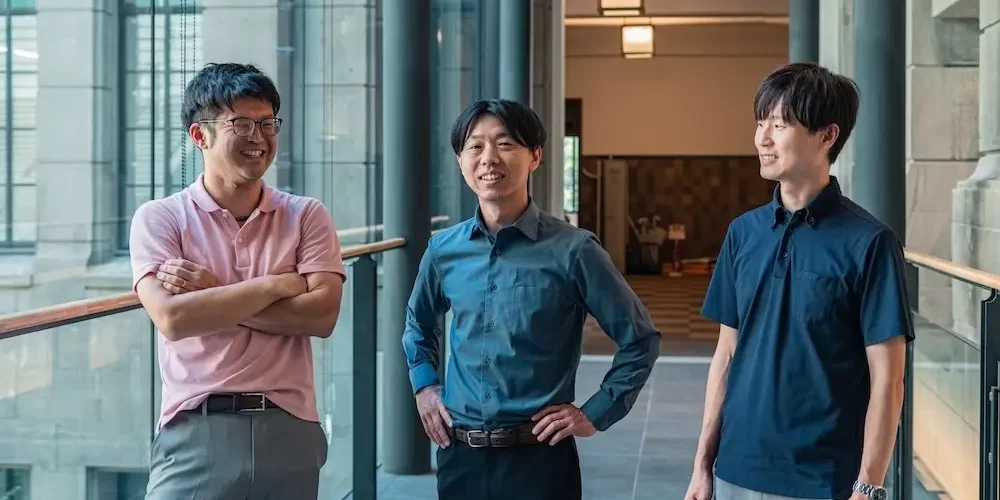
In this article, we spoke with Masanori Kimura (Director), Taro Sakurai (Assistant Director), and Tomohiro Ikeda from the General Affairs Section, Planning and General Affairs Department, Environmental Bureau, Kyoto City, about the background behind the city’s drive to transition to a circular economy and the objectives of the new programme.

Interviewee Profiles:
Director, General Affairs Section, Planning and General Affairs Department, Environmental Bureau, Kyoto City
Taro Sakurai
Assistant Director, General Affairs Section, Planning and General Affairs Department, Environmental Bureau, Kyoto City
Tomohiro Ikeda
Staff, General Affairs Section, Planning and General Affairs Department, Environmental Bureau, Kyoto City
Harmonising environment and industry by leveraging 1,200 years of culture
As symbolised by the term “Shimatsu no kokoro”, the culture of cherishing and continuously using objects and resources without waste has been passed down through people’s lives for over 1,200 years of Kyoto’s history. For Kyoto, the concepts of “circular economy” and “circulation” are by no means new. Traditional crafts and techniques, such as kurozome (black dyeing of textiles) and kintsugi (the art of repairing broken pottery with lacquer dusted with powdered gold), are infused with the essence of circular manufacturing. Recently, a new generation of artisans and successors has begun working in these industries.
Furthermore, a wide variety of circular projects are already underway in Kyoto City, including the RELEASE⇔CATCH project, which aims to circulate used clothing, household food waste composting initiatives, and events on the theme of circularity, such as Junkan Fes and Cities and Circularity. Given all of this, we asked why Kyoto City decided to launch a new circular economy foundation-building project.
Sakurai: “With the ‘Kyotoshi gyouzaisei kaikaku keikaku 2021-2025’ (Kyoto City Administrative and Financial Reform Plan 2021-2025), established in 2021, Kyoto City positioned the circular economy as one of its urban growth strategies. In 2023, the city welcomed Akihiro Yasui, a leading domestic expert in the circular economy, as an advisor, and the circular economy department, which we are part of, was launched last year.
“Since the circular economy also has an economic policy aspect, we had to consider measures that go beyond the conventional environmental field. We spoke with businesses and consulted with our city’s industrial departments to plan this project from scratch.”
Kimura: “In Kyoto City, a business culture of environmental consideration is already well-established. There is also a wide variety of players, including universities and intermediate support organisations like NPOs, that can serve as partners. I felt that the groundwork for a transition to a circular economy was already in place.
“On the other hand, we found that recognition and networking on the topic of the circular economy were not yet sufficient, which led us to launch this programme centred around a learning initiative. Furthermore, promoting the transition to a circular economy has been designated as one of our ‘leading projects’ in the ‘Shin kyoto senryaku,’ a plan for policies and initiatives to be implemented by fiscal year 2027, which was established in March 2025.”
A transition to a circular economy requires a cross-sectoral approach that includes not only environmental issues such as climate change, biodiversity, and waste but also urban development, culture, and industry. The city’s decision to go beyond conventional policy frameworks and implement a “circular economy foundation-building project” stems from its strong desire to create a new future for the city by leveraging Kyoto’s historical and cultural assets and fusing environmental and industrial policy.

The circular economy is a business opportunity to pioneer the future
To bring these ideas to life, the “Circular Business Design School Kyoto,” a learning programme for local businesses focused on the circular economy, is scheduled to launch in autumn 2025. Many businesses still view resource circulation and environmental consideration as a cost or burden. So, what is the thinking behind this programme?
Sakurai: “At the very root of this programme is the desire to change the mindset that environmental initiatives equal cost. We have a strong determination not to let environmental efforts end up being something to endure or struggle through. By adding the element of the environment to various fields like economic activity, local communities, and culture, we want to enhance the value of the ‘environment’ itself.”
Kimura: “I believe it’s very difficult and unrealistic to transform a business all at once, but we can turn a crisis into an opportunity. In the not-so-distant future, regulations will surely be tightened, and various constraints will emerge due to resource depletion. Learning about the circular economy is crucial as a way to prepare for these future risks.”
In Europe, for example, the new Circular Economy Action Plan was adopted in 2020 as one of the pillars of the European Green Deal, which was announced in 2019. This has been followed by the rapid introduction of legislation in key areas identified in the plan (electronics and ICT, batteries and vehicles, packaging, plastics, textiles, and construction). As market rules change, many companies are being forced to adapt, with examples including the ESPR (Ecodesign Regulation for Sustainable Products), which came into effect in 2024, and the CSRD (Corporate Sustainability Reporting Directive), which will apply from 2025.
In line with these trends, Japan formulated the “Circular Economy Vision 2020” in May 2020 and the “Growth-Oriented Resource Self-Sufficient Economy Strategy” in March 2023. In the 2025 “The Fifth Fundamental Plan for Establishing a Sound Material-Cycle Society”, the circular economy was explicitly positioned as a national strategy. Furthermore, the legal framework for the transition is rapidly advancing, with the amendment to the “Act on the Promotion of Effective Utilisation of Resources” passing in May 2025.
There is a saying that “markets move with policy,” and indeed, a time when national strategies and legal regulations are changing so drastically is an excellent opportunity to create new businesses and innovations.

Sakurai: “We want business owners to view the circular economy as a business opportunity for paving the way to the future. I once spoke with a business owner who practices the circular economy, and they shared, ‘It’s not necessary to change your entire business. But incorporating circularity into 10 or 20 per cent of your operations as a hedge against future risks helps keep a company healthy.’ The circular economy isn’t so much about environmental consideration as it is a management strategy for surviving in the future.”
Ikeda: “Ultimately, we want this programme to create products that consumers will look at and think, ‘I’d like to buy that.'”
In recent years, the number of companies and startups in Japan that are working to transition to a circular business model has increased, and investors and financial institutions are becoming more eager to invest in this field. While it’s difficult to aim for a complete business model from the start, using this programme as a catalyst to get on board with this major trend will allow companies to get ahead of future market changes.
Cross-sector collaboration drives new business opportunities
The programme will offer support from a diverse team of experts and mentors at the front lines of the circular economy in Kyoto, across Japan, and worldwide. Participants will also have the opportunity to take part in fieldwork in central Kyoto, where many citizens and businesses are already implementing circular initiatives, and in Keihoku, a forestry town in northern Kyoto City that has supported Kyoto’s urban development and where participants can experience the circularity of a satoyama environment.
The programme’s multifaceted structure will also support businesses eager to adopt circular practices by providing opportunities for participants to match with diverse partners, network with peers, and even create prototypes for the future real-world implementation of their circular business models. We asked the three officials to summarise the value of participating in the programme.
Sakurai: “We believe there are three main benefits. The first is the opportunity to create a prototype with direct advice from diverse experts and mentors through the programme. The second is the fieldwork, where you can visit sites that are already putting the circular economy into practice, from traditional industries to startups, and gain real-world circular knowledge cultivated in Kyoto.”
Kimura: “And the third is the chance to meet a diverse range of players from different industries and communities, people you might have had difficulty connecting with before. Players from various industries will participate under the theme of the circular economy. This is an unprecedented programme. We are preparing a venue and mechanisms to avoid an unbalanced industry mix among the participants, which will induce new chemistry. While this is a challenging endeavour, we are greatly looking forward to the new collaborations, partnerships, and circular businesses that will emerge from it.”
Sakurai: “I think it’s interesting that we’re attempting an industrial approach with the environment as the foundation. What kind of chemistry will develop among the people who gather here? What will their next step be? We hope that as many of the ideas born from the programme as possible will be implemented in society.”
This programme is unique in that the city’s Environmental Bureau will act as a hub for various sectors, connecting industry and culture from an environmental perspective to support the creation of circular business models. This approach of designing a space where diverse people can connect is one of the essential components of achieving a circular economy. When people with diverse perspectives and values interact, the likelihood of discovering new value in existing assets and waste increases, making circular business models more viable.
A circular ecosystem will be built in Kyoto City through the programme, where participants will influence each other and generate new businesses. These individual initiatives will come together to drive a systemic change for the entire city. With this programme, Kyoto City is looking ahead to a new kind of growth based on circular principles.
Ikeda: “This programme is a huge challenge for us in the government as well. We would be delighted if participants joined us in this challenge. We look forward to receiving applications.”
Editorial note
A circular future is a fitting path for a city like Kyoto, where a circular lifestyle and manufacturing have been rooted for centuries. However, in the modern era, where mass production, consumption, and disposal are the norm and various issues like climate change and resource constraints have become apparent, creating a circular future requires a careful and bold effort. This means unravelling the wisdom embedded in culture and tradition, inheriting its essence, and generating future-facing innovations. The path will surely not be an easy one.
However, to secure prosperity for the next 1,000 years under the new economic and social system of the circular economy, it is essential to take on this challenge sooner rather than later. Fortunately, this programme includes government officials, local support organisations, partners, and experts who are genuinely dedicated to supporting this endeavour.
If you are a business owner who wants to seize a new business opportunity at this time of change, we encourage you to consider participating in the programme. We hope you will discover new connections and hints for creating businesses that will lead to a better future for your company and for Kyoto in 10, 100, and even 1,000 years from now.
Note:
This program will be conducted entirely in Japanese.
[Launching October 2025] Circular Business Design School Kyoto
Kyoto is home to timeless assets nurtured over 1,200 years: the spirit of “Shimatsu no Kokoro”, circular ways of living, and a culture of craftsmanship. We are facing urgent global challenges such as climate change and biodiversity loss. To create a truly circular future requires drawing upon this wisdom, applying it to the present, and carrying it forward into the future. To this end, Harch Inc., which operates IDEAS FOR GOOD, will launch a new learning program in October 2025. By combining Kyoto’s deeply rooted circular wisdom with cutting-edge insights into the circular economy, the program seeks to envision and achieve the future we aspire to. “Decode Culture, Design Future”──a circular future rooted in tradition, from Kyoto.
Official website: https://cbdskyoto.jp/
Photo by Asuka Sasaki.
Original article written by Yu Kato, published on IDEAS FOR GOOD.
Translated by Zenbird Editorial Team.