 Zenbird Editorial Team
Sponsored by Yokohama City
The Asia-Pacific Circular Cities Forum (APCC-Forum), an international conference on the region’s sustainable future, opened in Yokohama. The forum aims to be a key platform for Asia-Pacific cities to work together toward becoming circular cities.
Local governments, including the City of Yokohama, joined international organisations and circular economy practitioners from Japan and abroad to discuss how to move from a linear economy to a circular one.
We draw on the speakers’ insights and examples from leading cities to examine where the circular economy in Asia-Pacific stands today and where it may head next.
Solidarity and the possibilities of cities facing resource constraints and climate change
Opening the forum, Yokohama Deputy Mayor Jun Matsuura highlighted the importance of the Asia Circular Cities Declaration (ACCD), launched under the leadership of the City of Yokohama and ICLEI Japan.
Matsuura: “Today, we are facing a set of major and interconnected challenges, including climate change, resource constraints, and energy issues. The transition to a circular economy, which allows economic growth and lower environmental impact to go hand in hand, is a major transformation that will fundamentally change how we produce, consume, and live.”
Matsuura noted that Asia-Pacific is home to about 60% of the world’s population and is a global manufacturing hub. As a result, the region holds the key to whether the circular economy succeeds worldwide. Since its launch last year, 26 cities with a combined population of 57 million had joined the ACCD by the time the forum opened. The forum is a historic platform for turning the declaration into more than words, through knowledge sharing, stronger policymaking capacity, and concrete action and collaboration.
He then posed a question: “But who will make this transition happen, and where will it take place?” National governments, businesses, consumers, and many other stakeholders all have a part to play. But the place where all of these come together and where change is put into practice in society, Matsuura argued, is the city.
Local governments can create conditions that make it easier for businesses and residents to act. They can also encourage collaboration across sectors such as waste, energy, transport, and water. In this way, cities can serve as the foundation for turning ideas into action.
Can a declaration serve as a “common language” for various paths?
The following plenary session, “Pathways to a Circular Economy in Asia-Pacific Cities,” explored how the transition can take shape according to each region’s characteristics. Social and economic conditions vary widely across Asia-Pacific cities. For that reason, flexible models that fit local realities are needed, rather than a one-size-fits-all approach.
The first speaker was Sarah O’Carroll of the Ellen MacArthur Foundation, an international nonprofit working to accelerate the transition to a circular economy.
O’Carroll: “National policy matters for advancing the circular economy because it sets the rules and direction and creates the conditions in which businesses and cities operate. But many of the decisions that shape how materials move in everyday life are made in city planning, procurement contracts, waste collection systems, and neighbourhood communities. This proximity to businesses and local communities is a strength that cities have and national governments do not.”
Referring to the Foundation’s Urban Policy Levers framework, O’Carroll explained that cities do not all need to follow the same sequence. Cities with limited budgets can start with procurement, while cities with little regulatory power but strong convening ability can connect communities and businesses.
She stressed that shared frameworks and declarations are not valuable because they force every city to take the same actions. Their real value lies in building a community that creates a common language, enables mutual learning, and makes it easier to identify shared barriers. With a common language, she said, joint pilot projects, joint policymaking, and access to finance all become easier.
At the same time, she warned against over-reliance on waste-to-energy, which can become a short-sighted fix. Instead, she called for gradually accelerating circular solutions that regenerate nature and build resilient economies, alongside resource recovery and recycling.
Providing an example of city-level practice, Mark Gregory C. Afable, Head of the City Information Office, City of Borongan in the Philippines, took the stage. The city of about 72,000 people sits on the Pacific coast and is frequently hit by typhoons. Borongan once relied on concrete embankments to control river flooding. Using national climate adaptation funding and other resources, the city kept some of the concrete structures while planting bamboo along the most vulnerable riverbanks and native trees on the hills upstream. In doing so, it shifted toward river management that helps sustain natural cycles.
Afable: “Concrete starts cracking from the day it is poured. But bamboo holds the soil and grows back. Forests upstream slow the flow of water and grow stronger year after year. We have built protection that regenerates itself.”
Building on this idea, the city has introduced household food waste composting, separate management of e-waste, and community-wide activities run with residents. Borongan’s experience shows that drawing on existing natural assets and community ties can create protection and adaptation systems that gain value over time.
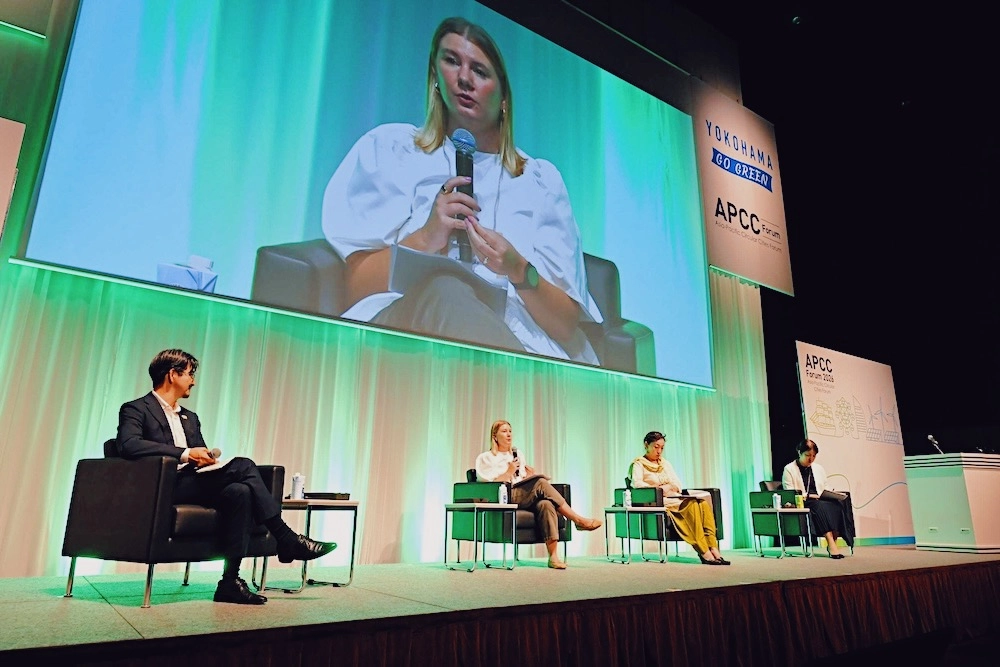
In the panel discussion that followed, Akiko Yamamoto of the United Nations Development Programme (UNDP), Rieko Kubota of the World Bank’s Tokyo Development Learning Center (TDLC), and O’Carroll of the Ellen MacArthur Foundation shared their views. Yamamoto explained that UNDP’s new Strategic Plan (2026–2029) also sets the goal of accelerating human development while reducing pressure on the planet.
Yamamoto: “The circular economy is not an environmental movement. It is a new economic model that shifts us from linear to circular. One challenge specific to Asia is that we cannot ignore informal workers and waste pickers. They need to be included in government safety nets.”
She pointed out that systems developed in Europe, such as extended producer responsibility (EPR), should not simply be copied into Asia-Pacific. They need to be adapted to each country’s social context and to the realities of its informal sector.
Kubota of the World Bank TDLC addressed the challenge of reducing inequality while achieving a circular economy.
Kubota: “For the ACCD to be more than a declaration, we need not only practical experience-sharing between cities, but also a bridge that connects that experience to actual lending operations and turns it into bankable projects.”
Praising the success of community-led recycling models such as the waste banks in Makassar, Indonesia, she also highlighted the importance of phased financing designed for each stakeholder group to strengthen local governments’ financial footing.
Because there is no single right answer, a common language becomes all the more meaningful. What emerged from this discussion was a picture of cities that start from different places but learn from one another through the shared framework of a declaration and link that learning to policy and finance. Circular models that draw on local nature and community strength have the potential to turn the diversity of Asia-Pacific itself into an asset.
GREEN×EXPO 2027 as a stage for real-world implementation, and co-creation beyond city borders
The next session was titled “From Vision to Action for Circular Cities: Co-creation and Development through GREEN×EXPO 2027.” Misa Kemmiya, Executive Director from Department of Sustainability Management Japan Association for the International Horticultural Expo 2027, which will be held in Yokohama from March 19 to September 26, 2027, spoke first.
Under the theme “Scenery of the Future for Happiness,” the expo will showcase a future in which nature, people, and society thrive together. Participation from 71 countries and five international organisations is planned.
Kemmiya emphasised that GREEN×EXPO 2027 is not merely an exhibition, but a place to put a range of initiatives, including the circular economy, into practice in society. Plans for the venue include sustainable procurement and resource circulation policies, reuse of timber from Expo 2025 Osaka, Kansai, and the composting of plant residues.
Kemmiya: “Value creation does not come from a single technology or cutting-edge innovation. It comes from changes in awareness and behaviour across society.”
Kemmiya then moderated a discussion on circular economy practices in cities and how they can expand across Asia-Pacific.
Norio Tomioka, Executive Director of Global Initiatives Department, Policy Administration and International Affairs Bureau, City of Yokohama, described Yokohama’s efforts with one keyword: co-creation. He introduced Yokohama Circular Link, an initiative to speed up the transition to a circular city. It maps resource flows in areas such as food, construction, and consumer goods, with the aim of creating new cross-sector business models. In the Minato Mirai district, the city is measuring resource flows at commercial facilities, and efforts are being made to upcycle waste popcorn from movie theaters into beer.
Tomioka: “No single actor can achieve a circular economy alone. What matters is connecting different sectors and creating together.”
Elizar Jr Lequin Sabinay, Executive Assistant V, Provincial Planning and Development Office and Investment, Cebu Provincial Government in the Philippines, described a challenge facing the province: waste management is fragmented across individual municipalities. In response, the province has developed a concept for GX Park Cebu, an integrated waste management facility that would collect, process, and recover resources from waste across multiple municipalities. A feasibility study covering some areas began in September 2026.
Sabinay: “Waste does not recognise political or administrative boundaries. That is why we need to think about the circular economy beyond municipal borders wherever possible.”
Cebu Province has long partnered with companies in Yokohama and has received technical cooperation and know-how from them. Drawing on insights from other organisations and cities at the forum, as well as findings from experts and partners, the province plans to launch full-scale activities.
Tamara Iskandar, Urban Strategy Lead at Circle Economy, a Dutch nonprofit, outlined three trends among circular cities in Europe: setting circular rules through public procurement and other tools, mapping resource flows, and collaborating among multiple cities. At the same time, she noted shared challenges such as gaps in data, talent and knowledge, as well as public-private collaboration and financing.
Iskandar: “First, measure your resource flows and understand where you are now. From there, identify the key areas and start with just one or two sectors.”
Fernando Gomez, Head of the Future of Materials and Member of the Executive Committee at the World Economic Forum, spoke about the role of the private sector in the circular economy. According to a corporate survey, the share of companies that see the circular economy as strategically important has grown from about 30% three years ago to about 74% in 2026, and is expected to reach about 96% in three years. This reflects growing awareness of business benefits beyond lower environmental impact, including competitive advantage, profitability, stronger supply chains, and resource security.
Gomez: “Companies are ready. There is growing recognition that these strategies generate revenue and create economic value, and the willingness to collaborate is increasing at many levels.”
The following panel discussion focused on how to realise and accelerate circular cities.
Sabinay stressed the need for a platform where municipalities can learn from one another and work with businesses and local communities to overcome differences in their waste management systems. Iskandar said, “We don’t need to have the best data in the world. What matters first is a shared understanding of where we are now and moving in the same direction,” urging participants to assess the current situation and get started. Gomez agreed that the challenge lies in the “how,” and suggested rethinking what the private sector means in an urban context. He named three priorities: using data, making use of companies’ advanced technologies, and encouraging collaboration between local businesses and governments.
Tomioka pointed to the need to expand resource-flow mapping beyond individual pilot projects to the city as a whole. Repeating that “no single actor can achieve a circular economy alone,” he said that co-creation among different actors, including government, business, and local communities, is the key to advancing the transition to a circular city.
As this session showed, many organisations in Asia-Pacific already see the circular economy as a pillar of their business strategy and are getting ready to collaborate. The discussion also made clear what is needed for the next step: platforms for learning across borders, data to build a shared picture of the current situation, and steady, locally rooted co-creation. With GREEN×EXPO 2027 as one starting point, hopes are high that spaces for sharing practical knowledge will spread from Yokohama across Asia-Pacific.
From declaration to action: the ACCD’s next step for circular cities
“Cities are no longer just places where resources are consumed. They are becoming places that create new value through circularity and innovation,” Takeshi Sekiya, Vice-Minister for Global Environmental Affairs at Japan’s Ministry of the Environment, made this point at the ACCD Gathering and Closing Session that concluded the two-day forum. He noted that the ACCD builds on 14 years of achievements from the Asia Smart City Conference and described it as a new driving force for collaboration between cities. He also paid tribute to the City of Yokohama for leading this first edition of the forum.
In a video message, Armida Salsiah Alisjahbana, Under-Secretary-General of the United Nations and Executive Secretary of the United Nations Economic and Social Commission for Asia and the Pacific (ESCAP), pointed out that cities, where climate change, resource depletion, waste, and pollution are most visible, are also where workable solutions can have the biggest and most immediate impact. Mike Josef, Mayor of Frankfurt, Germany, who attended on behalf of the signatory cities of the European Circular Cities Declaration, described Frankfurt’s partnership with Yokohama, a partner city since 2011, as a bridge between Europe and Asia.
The closing session also announced new ACCD signatories. Togo Uchida, Executive Director of ICLEI Japan, which serves as the ACCD secretariat, shared that 17 cities had joined, including Kobe in Japan and cities in India, Indonesia, Nepal, Pakistan, Bangladesh, the Philippines, and Malaysia. This brings the ACCD to 43 cities in 11 countries, representing a population of about 82 million.
A survey of signatory cities conducted by ICLEI Japan found that market creation and local rules are common bottlenecks, more so than planning and awareness-raising. In response, the ACCD has adopted its first action plan, ACCD Action 2026. It launches three working groups: the ACCD Good Practices Working Group, which will collect and share good practices; the ACCD Solution Matching/Co-Creation Working Group, which will promote the adoption of private-sector solutions; and the ACCD Progress Monitoring Working Group, which will build a system to track signatory cities’ progress. Concrete activities are set to move forward toward 2027.
Reporting on the outcomes of the youth session, Takaki Kiyonaga shared examples of young people taking action in disaster resilience, entrepreneurship, and policy participation. He noted that all of these examples were built on collaboration with local governments, businesses, universities, international organisations, and civil society, and stressed that “when young people get the chance to learn by doing, develop their ideas, and take action, they can create greater impact.” He also announced the launch of a student project from Yokohama, in which local students will research urban challenges in Asia-Pacific cities and develop practical ideas and solutions. “It is often said that young people represent the future, but they can also shape the cities of today,” he concluded. He expressed hope that the two days of discussion and the student project would inspire future generations ahead of the APCC and the 9th Asia-Pacific Urban Forum (APUF-9), both to be held in Yokohama in 2027.
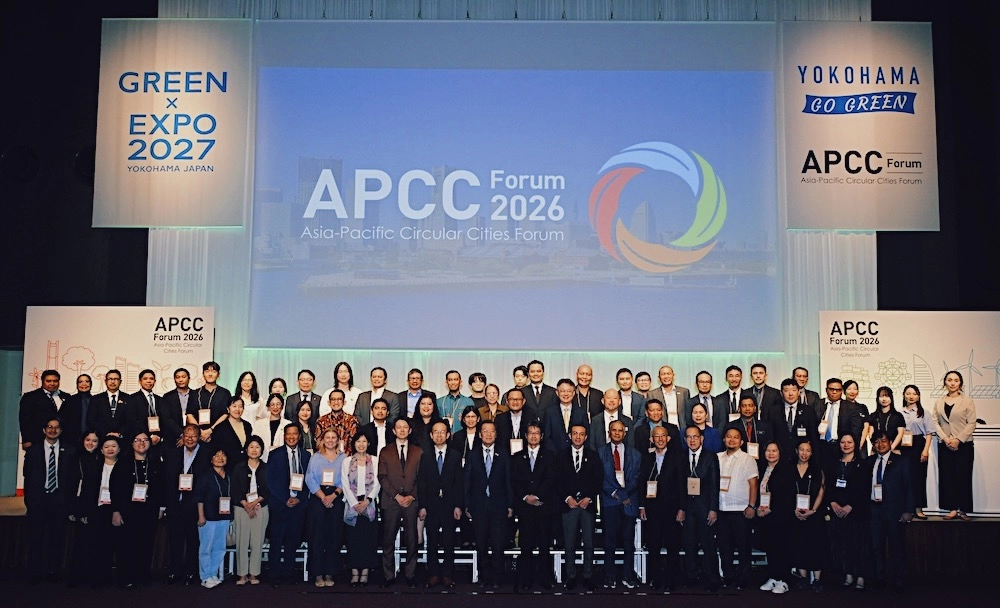
Finally, speaking on behalf of the organisers, Deputy Mayor Matsuura said, “At this year’s APCC Forum, the ACCD has taken a significant step forward, moving beyond a declaration to become a platform for tangible action.” In 2027, during GREEN×EXPO 2027, Yokohama will host the APCC-Forum, APUF-9, and CIR-BAY, an international circular economy trade show that is expected to bring together about 350 exhibitors from Japan and abroad and 30,000 visitors. Matsuura said next year’s APCC-Forum will be scaled up, and announced plans to designate August 30 to September 3, 2027, as “Yokohama Circular Week,” creating opportunities for people involved in the circular economy from Japan and around the world to gather and connect in Yokohama.
From a place where cities share knowledge to a place that produces concrete action and co-creation—the next stage begins in Yokohama in 2027.
Originally published on Circular Economy Hub.
[Reference] Asia-Pacific Circular Cities Forum 2026