 IDEAS FOR GOOD
[Kyoto Circular Economy Special Feature]
This feature series is a collaborative project between IDEAS FOR GOOD and Kyoto City, exploring the present and future of the circular economy of Kyoto. How can the spirit of “Shimatsu no kokoro,” together with circular living and a centuries-old culture of craftsmanship in Japan’s ancient capital, be harnessed to drive innovation that will shape tomorrow’s Kyoto? And how can they give rise to circular businesses that will thrive for the next thousand years? Together with Kyoto City, local businesses, and policy advisor Akihiro Yasui, we explore Kyoto’s unique value and potential through the lens of the circular economy.
Have you ever considered the ultimate destination of clothes you’ve given away so they wouldn’t become waste?
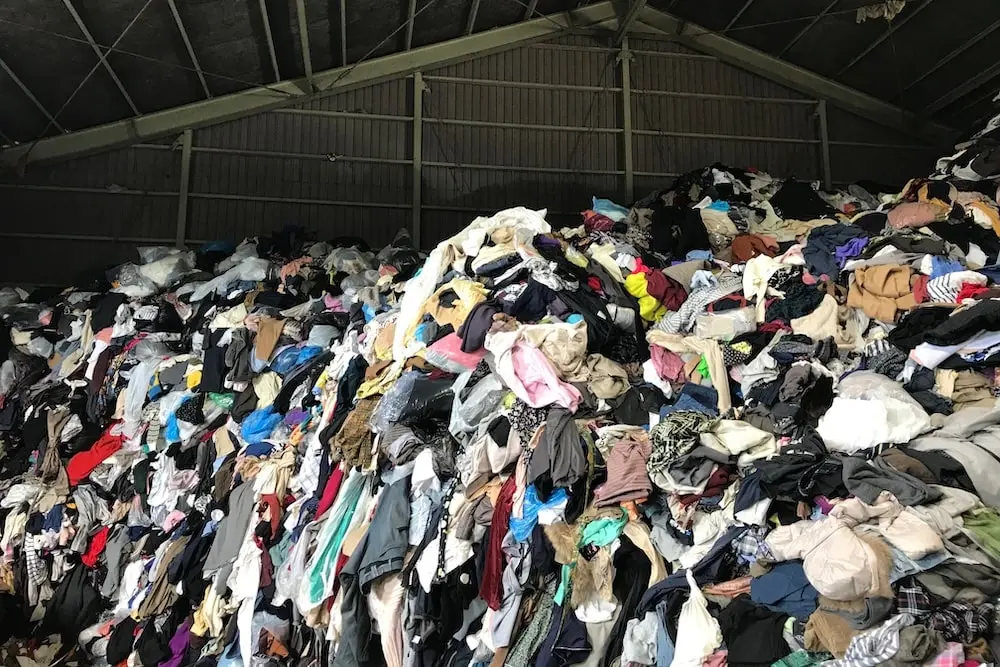
We gather them from our wardrobes, pack them into bags, and drop them off at collection boxes or second-hand shops. We believe that these clothes will then reach someone else. However, the reality is not so simple. Only a small fraction of clothes are reused; most are incinerated or “recycled” into industrial materials such as cleaning rags or sound-absorbing materials for cars.
In Japan, approximately 770,000 tonnes of new clothing are sold by apparel shops annually, while around 670,000 tonnes are discarded as general waste or recyclables. Of this, incineration and landfill account for 510,000 tonnes, with reuse (repurposing as second-hand clothing domestically) at approximately 10,000 tonnes, and material recycling (into rags, shoddy (recycled fibre), etc.) at around 70,000 tonnes (according to the Ministry of the Environment).
The reason so much is incinerated is that many garments use “blended fibres,” combining two or more types of fibres like cotton and polyester, making garment-to-garment recycling extremely difficult. Even if recycled, it is challenging to extract pure coloured threads from mixed fibres again, resulting in low-saturation, dusty-coloured material. This colour is difficult to use for new clothing, and consequently, much of it is discreetly transformed into industrial materials.
Kyoto-based company colourloop Co., Ltd. is tackling this deep-rooted challenge with the bold idea of recycling clothing by colour rather than by material. Its CEO, Motoko Uchimaru, has developed a proprietary technology, the “Colour Recycle System®︎,” which sorts and rematerialises waste fibres by colour. We spoke with Uchimaru, who transforms waste fibres into valuable resources through colour, about her initiatives and her vision for a circular future.
Interviewee Profile: Motoko Uchimaru
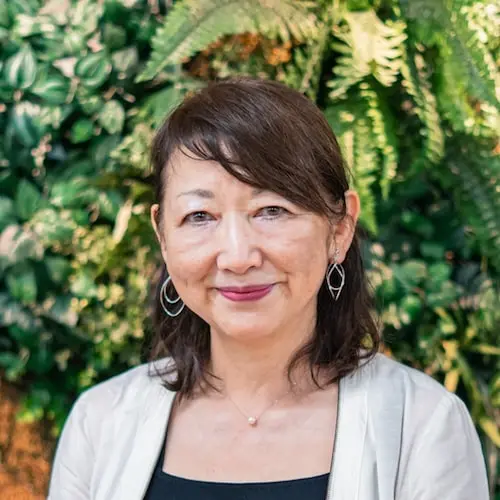 CEO of colourloop Co., Ltd. Graduated top of her class in Textiles from Middlesex University (UK). Holds a Ph.D. in Engineering from Kyoto Institute of Technology. Worked as a textile designer in Kyoto, planning fashion and interior materials. Upon learning about the current state of textile waste, she questioned the continuous production and began researching textile recycling at the Kyoto Institute of Technology Graduate School. She established colourloop Co., Ltd. with the belief that by exploring more attractive materials made from waste fibres and proposing materials and products that consumers find appealing, the value of recycled products could be increased, thereby contributing to a circular society.
Fashion industry’s “blended fibre” dilemma
For many years, Uchimaru worked as a textile designer, engaging with threads and fabrics in the world of fashion and interiors. Behind the glamorous facade of the industry, she was deeply saddened by the reality of vast quantities of fibres being discarded.
Driven by the conviction that “simply producing is not enough,” Uchimaru embarked on a research path. Immersed in textile recycling research during her doctoral programme at the Kyoto Institute of Technology, she confronted the structural challenges facing the industry.
Uchimaru: “65% of the clothes we wear are made from two or more types of materials. Furthermore, approximately half (47%) are made from three or more types of materials. For example, we might use a cotton base for comfort but add polyester to prevent wrinkles. Polyurethane is included for stretch, and rayon for a slight sheen. Before long, we have a blend of four or five different types.”
Even if materials could be separated, the mixing of various colours would result in a dust-like colour, significantly diminishing the product’s value. Unless this issue is resolved, there is no future for textile recycling.
Uchimaru: “While the three primary colours of light mix to create white, object colours tend to become darker when mixed. As a result, instead of a beautifully calculated grey, it often turns into an unpleasant shade of grey, making it difficult to create appealing products. Therefore, I decided to start by creating something that general consumers would find ‘lovely’ and thereby generate interest in recycling.”
The solution Uchimaru arrived at was remarkably simple yet innovative. If separating by material is difficult, then separate by colour.
Uchimaru: “When I considered what makes a material appealing, I felt it could only be colour. From there, I began researching recycling through colour separation. First, I roughly sorted the clothes and established rules to avoid undesirable colours. I believed that by finding rules based on what we wanted to create, new manufacturing would become easier.”
Transforming waste fibres into “colour materials” through a shift in perspective
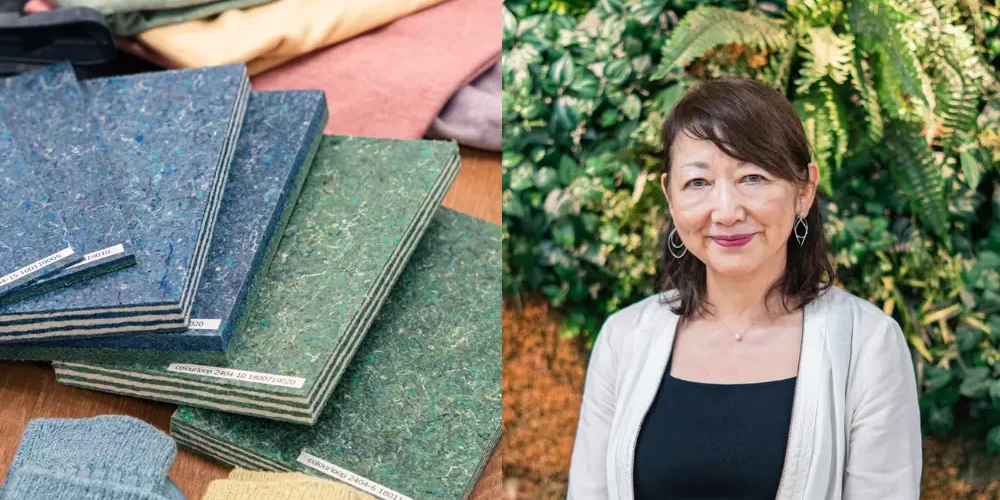
The Colour Recycle System®︎ developed by colourloop resolves these challenges in textile recycling. It sorts discarded textile products by colour, regardless of material, and by deconstructing the fibres, they are reborn into threads, sheets, or boards that retain their original colour without needing new dyeing processes. This system reconceptualises waste fibres not as rubbish but as “colour materials.”
Products made with the Colour Recycle System®︎ can be reused by collecting them again and sorting them by colour. Furthermore, faded or frayed clothing can also be used as fibre material.
Uchimaru: “After colour separation, the fibres can be unravelled and turned into pigments or reinforcing agents. It’s also possible to mix them with resin to create moulded products, combine them with pulp to make paper, or form them into wadding for felt or yarn.
“Because this system uses fibres as colour materials, it produces deep hues and unique textures, and since no new dyes are used, the environmental impact is also low.”
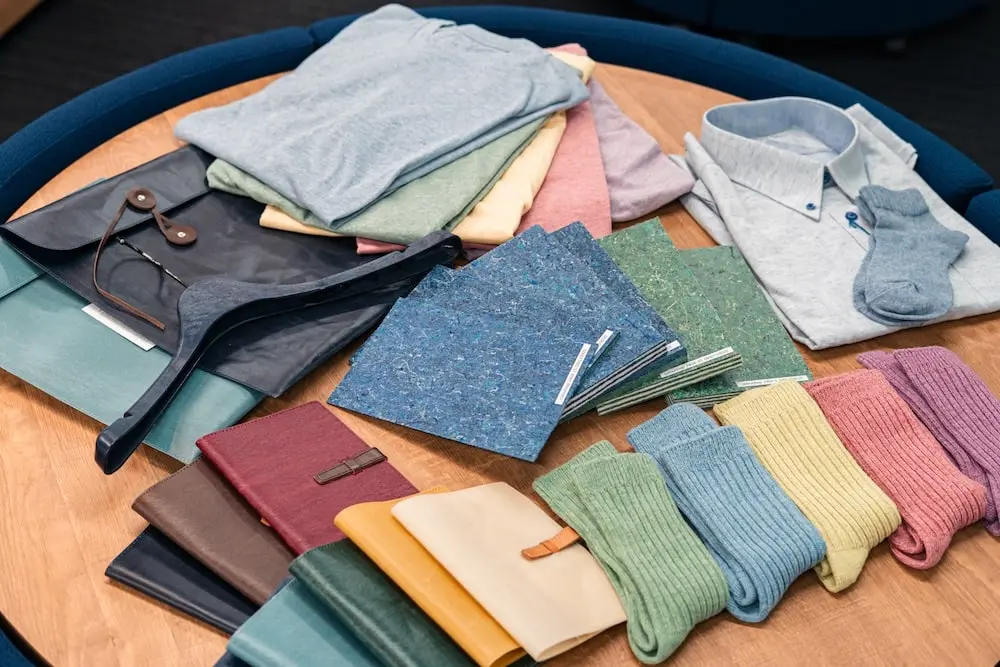
The strength of this system, which recycles by colour rather than material, lies in its ability to handle diverse blended materials that were previously considered difficult to recycle. It produces materials free from the dull colours characteristic of recycled products, which was once a significant challenge. Instead, the unique mixed feel resulting from various fibres creates a deep, rich texture and a warm appearance. Perhaps these are colours that hold stories woven with memories and time, unlike virgin materials.
Creating material value through technology and design
The company’s strength lies in integrating a designer’s sensibility with traditional engineering-focused recycling technology to develop materials with unique properties from recycled fibres. One such example is “TEXLAM,” a board material that utilises waste fibres as a reinforcing agent.
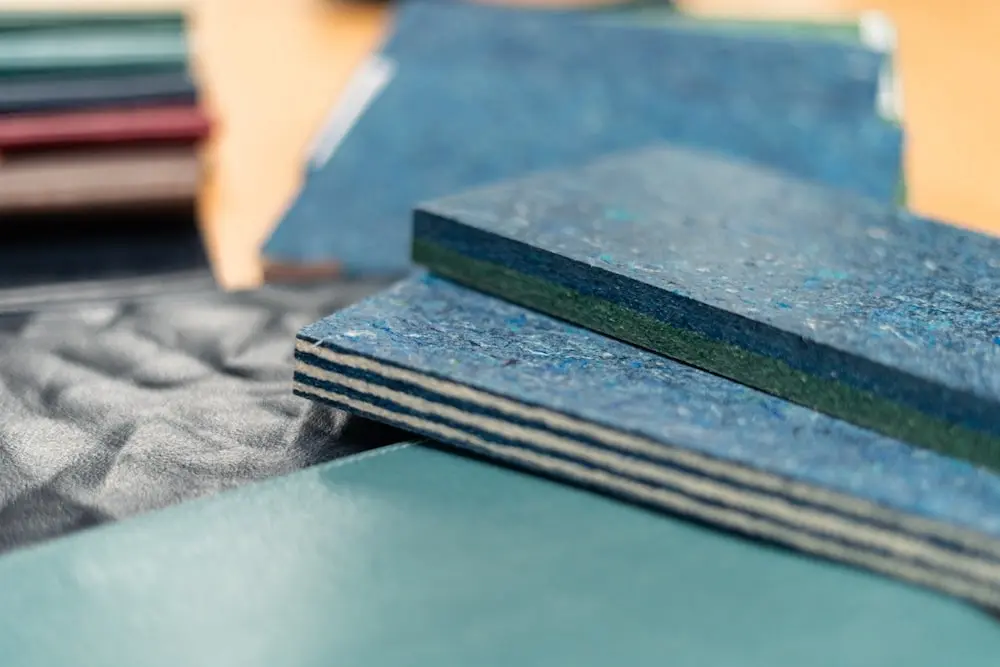
Uchimaru: “TEXLAM is characterised by its ability to freely change thickness, density, and the design of its cross-section. For instance, when used for a tabletop, it can be made high-density for increased strength, or low-density when lightweighting is required.
“The manufacturing method for this board has been researched for many years at the Kimura Laboratory at Kyoto Institute of Technology, and I added design elements such as colour and texture to it. Furthermore, we are also working on paper made from waste clothing and ‘fibre-to-fibre’ horizontal recycling that upcycles diverse garments. These challenges address the current situation where approximately 65% of the clothes we wear are made from blended materials.”
The company has also developed a variety of other materials. ReFIQ, a sheet material made from waste clothing, boasts high tensile strength (resistance strength to being pulled apart) while being easily cut with scissors or a utility knife. It also allows for delicate laser engraving, combining the functional value of strength with the aesthetic value of a unique texture derived from fibres.
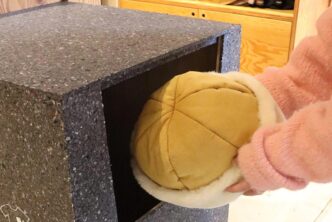
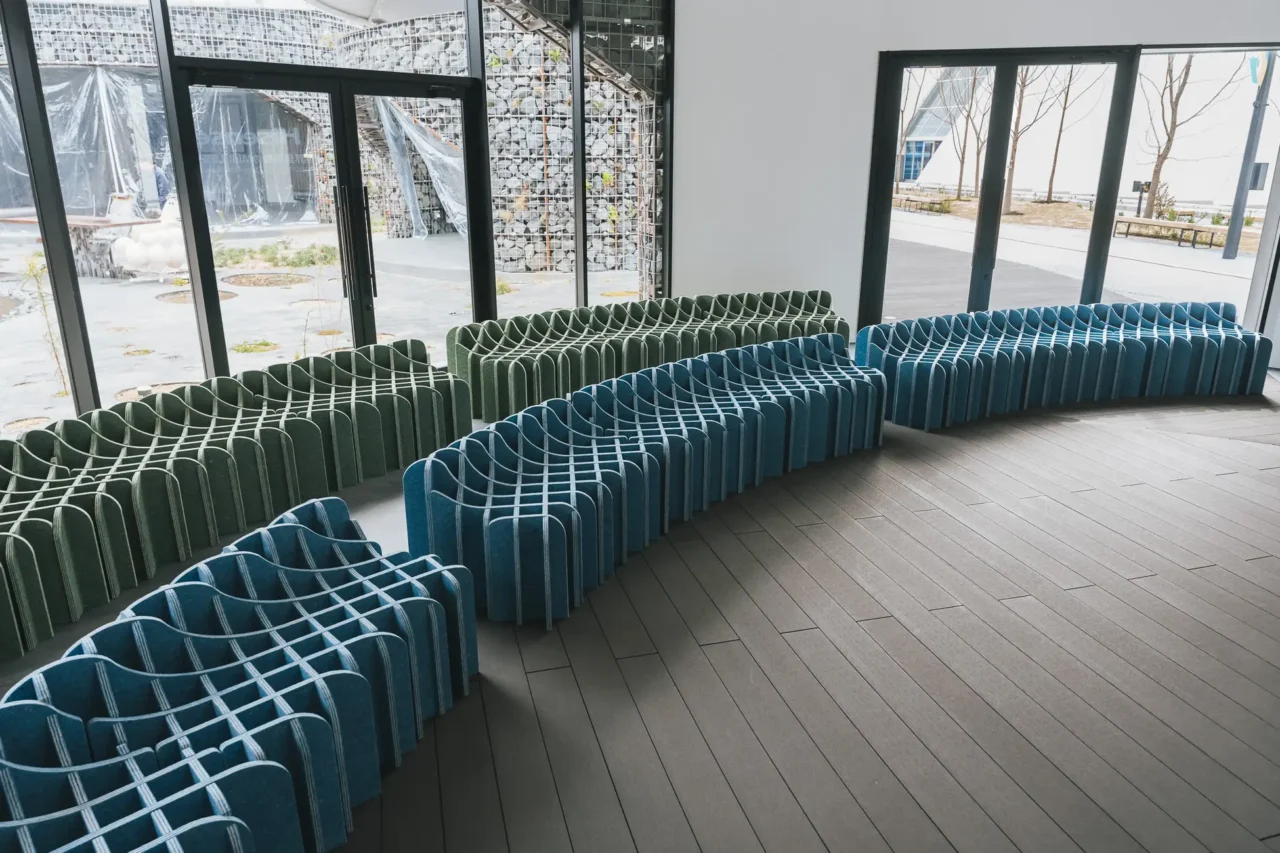
Leveraging these properties, TEXLAM board benches, made from approximately 3,000 T-shirt equivalents (100 grams per T-shirt) of recycled waste clothing, have been installed at EXPO 2025 Osaka, Kansai, welcoming numerous visitors.
Circulating materials into society: recycling weaves new stories
The circulation of materials made from waste fibres is also spreading through society via collaborations with schools and businesses.
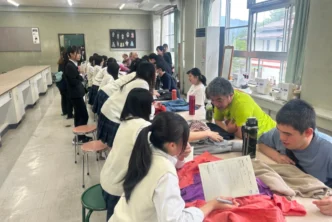
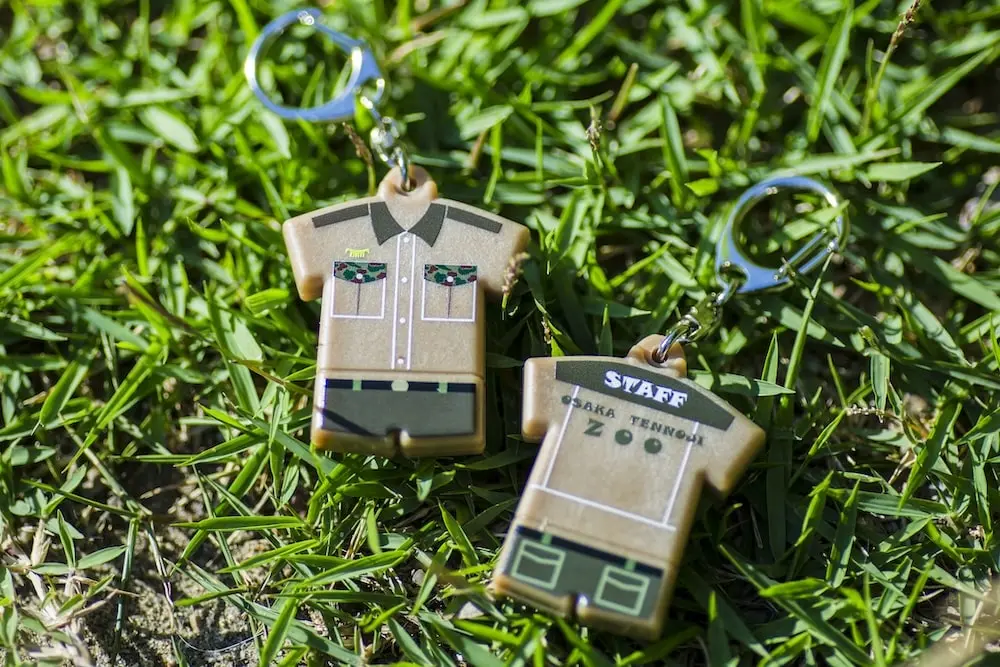
At Kyoto Municipal Kyoto Oike Junior High School, a project was implemented, in which graduating students’ uniforms, worn over three years, were collected and transformed into miniature uniform keychains as gifts. This preserved the uniforms, imbued with memories of school days and friendships, in a new form.
Uchimaru: “We are collaborating with uniform manufacturer Muratado on uniform upcycling initiatives. Muratado collects uniforms from graduating junior high school students, turns a portion into commemorative items, and reuses the remaining material for car interior components. These projects are highly commemorative and well-received by all involved.”
Having connected materials and memories in this way, Uchimaru now envisions an even larger, yet locally rooted, circular system.
Uchimaru: “Fundamentally, the ideal is local production for local consumption. Ideally, we would collect waste fibres by colour in Kyoto, create products from those materials, and have Kyoto City and the local government use them. This would make it a city-wide activity, closing the loop within the region. These days, we sometimes see news reports of waste clothing being sent overseas and piled up, but I believe we should take care of our own region’s waste ourselves.”
Collecting and processing waste textiles back into fibres within Kyoto City, transforming them into new products, and having citizens use them as furnishings for public facilities– such citizen-participatory activities could change people’s awareness and become a movement that creates new narratives in harmony with the local community and natural environment.
Uchimaru: “In the future, I hope to see a society where recycled materials play a leading role. Fibres that have served their purpose as clothing can be reborn as other products. We aim for a society where fibres, just like metals and glass, are circulated as much as possible.”
Even after serving their purpose as clothing or daily necessities, the new story of fibres continues. The future envisioned by colourloop is a scene from a circular society that repeatedly weaves the value and memories of objects.
Editor’s Note
The idea of sorting by colour rather than material teaches us that by questioning ingrained conventions and slightly shifting our perspective, we can shed light on seemingly intractable problems. colourloop’s challenge offers hints not only to the textile industry but also to how we approach all kinds of issues.
The power of technology, backed by research, and design that moves people’s hearts. Only with both these wheels turning can sustainability transform from an activity burdened by obligation into one that everyone wants to participate in daily. The circulation of materials that began in Kyoto will continue to be utilised in daily life, changing its form like a long-cherished tradition.
[Reference] colourloop Homepage (Japanese)[Launching October 2025] Circular Business Design School Kyoto
Kyoto is home to timeless assets nurtured over 1,200 years: the spirit of “Shimatsu no Kokoro”, circular ways of living, and a culture of craftsmanship. We are facing urgent global challenges such as climate change and biodiversity loss. To create a truly circular future requires drawing upon this wisdom, applying it to the present, and carrying it forward into the future. To this end, Harch Inc., which operates IDEAS FOR GOOD, will launch a new learning program in October 2025. By combining Kyoto’s deeply rooted circular wisdom with cutting-edge insights into the circular economy, the program seeks to envision and achieve the future we aspire to. “Decode Culture, Design Future”──a circular future rooted in tradition, from Kyoto.
Official website: https://cbdskyoto.jp/
Photo by Asuka Sasaki.
Originally written by Kaho Fukui, edited by Natsuki, and published on IDEAS FOR GOOD.
Translated by Zenbird Editorial Team.