 Zenbird Editorial Team
A recent survey, the 31st “Water-Related Lifestyle Consciousness Survey,” revealed that while more people in Japan are actively saving water, their overall interest in water-related issues is stagnating, pointing to a potential gap between habitual behaviour and genuine environmental concern.
The survey polled 1,500 residents across the Tokyo, Osaka, and Nagoya metropolitan areas to track public attitudes towards water. The results show a significant rise in water conservation, with 77.4% of respondents stating they practise it, up from 66.7% in 2019. However, the motivations appear to be shifting. While saving money on bills remains the top reason, other factors are gaining ground.
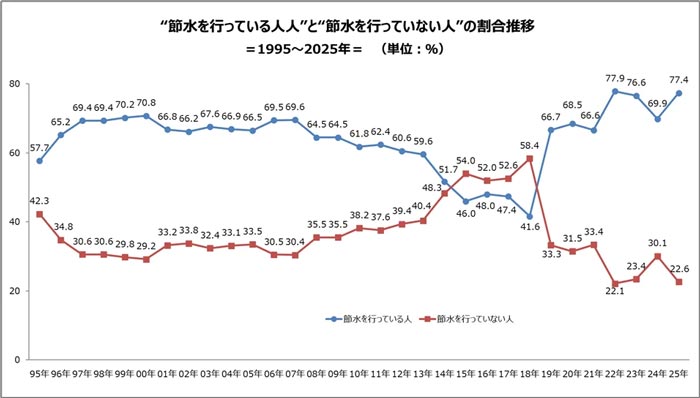
Professor Taikan Oki of the University of Tokyo, who provided analysis for the report, noted that conservation is becoming a social norm. The number of people who save water “because it has become a habit” or “because of the education I received” has increased, suggesting that conservation is becoming ingrained in daily life.
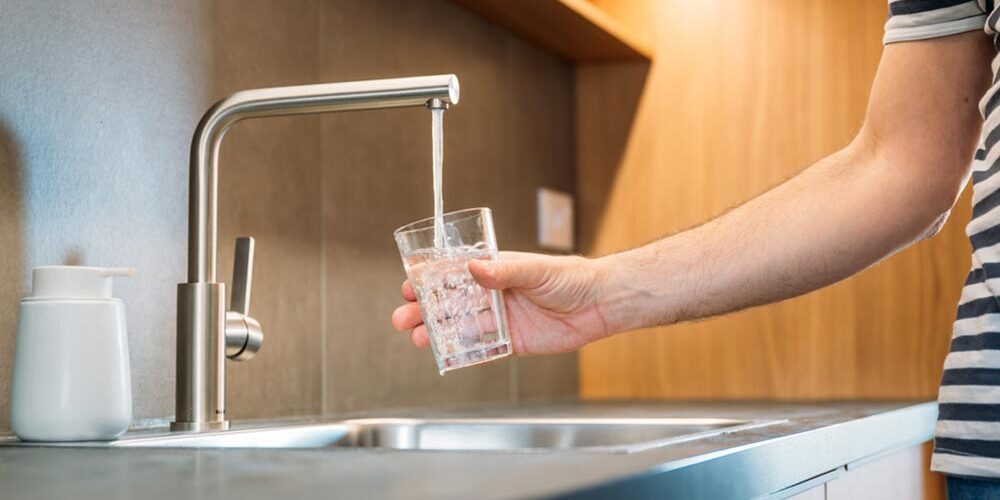
Public perception of tap water has also improved. On a 10-point scale, the general rating for tap water rose to 7.47 from 7.34 last year. The rating for tap water as a drinking source also increased to 7.02. Despite this, Professor Oki explained that the “evaluation of tap water for drinking is somewhat harsh,” as fewer people gave it a perfect score compared to the general-use rating.
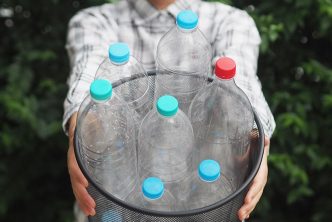
Conversely, the image of bottled water has declined. Professor Oki stated that “the image of commercially sold bottled water has become much worse compared to 2020.” Positive associations such as “delicious,” “long-lasting,” and “hygienically safe” all saw a decrease. This shift follows years of heightened global awareness about plastic waste.
Despite this, the survey found that direct environmental concerns were not the primary driver of this negative perception. Instead, Professor Oki suggests that overall public interest in bottled water itself may be waning.
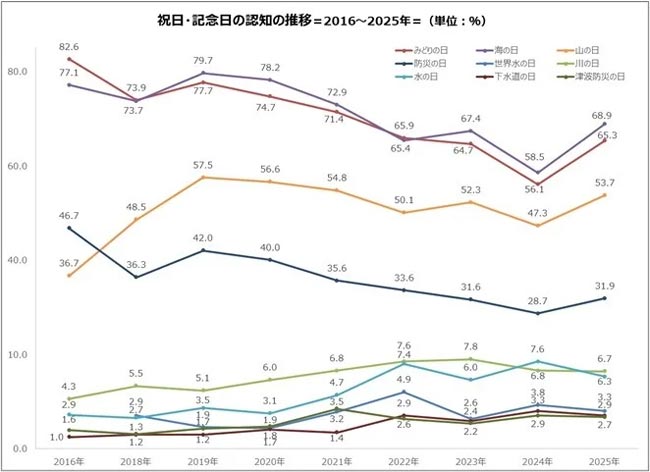
The survey also highlighted a challenge for awareness campaigns. The recognition of Japan’s “Water Day” (1 August) remains low at 6.3%, a slight decrease from last year’s record high. Professor Oki suggested that the “proliferation of related commemorative days is hindering the spread of awareness.” He added that a general trend of declining public engagement with such designated days, including national holidays, is observable. “It is thought that our interest in public holidays and commemorative days itself is waning,” he commented.
Global concerns over freshwater scarcity are growing globally due to climate change. While Japan is a water-abundant nation, changing weather patterns are threatening the stability of this resource. The survey’s conclusion that public action is driven more by habit than by deep-seated interest could be a cause for concern, while good, does also suggest possibly a lack of public readiness for more significant water challenges in the future.
[Reference] 31st Water-Related Lifestyle Consciousness Survey (Japanese)