 Zenbird Editorial Team
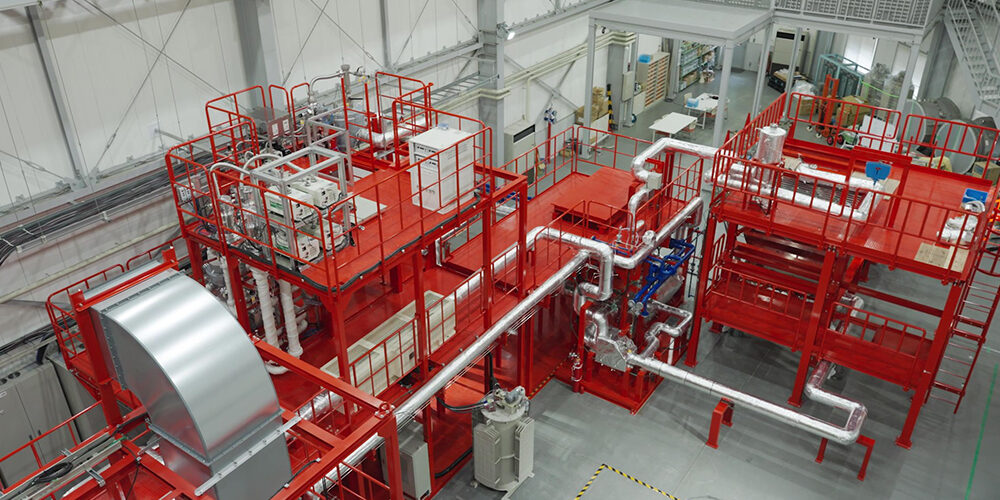
Kyoto Fusioneering Ltd. has revealed progress on its integrated test plant, UNITY-1, which is designed to demonstrate the essential technology for converting heat from nuclear fusion into electricity. The company released a video showcasing the plant’s development and its key systems last week.
The UNITY-1 facility, currently under construction in Kyoto, will prove the viability of the “fusion blanket and thermal cycle system.” This technology is a critical component for any future fusion power plant, regardless of the plasma confinement method used. It is designed to capture the high-energy neutrons produced by a fusion reaction, convert their energy into heat exceeding 1,000 degrees Celsius, and use that heat to generate power.
While fusion reactions have been achieved in laboratories, the technology to efficiently extract and utilise the resulting energy for practical purposes remains a major hurdle. Kyoto Fusioneering aims to solve this by pioneering these essential plant technologies.
UNITY-1 simulates the harsh environment of a fusion reactor, including strong magnetic fields of up to four teslas, without initiating an actual fusion reaction. The system uses a liquid metal, lithium-lead (LiPb), as a coolant and heat transfer medium. This material was chosen for its high thermal conductivity and chemical stability, as well as its ability to breed tritium, a hydrogen isotope that serves as fuel for fusion reactions.
Construction of the plant began in 2024, with the assembly of large-scale equipment, excluding the heat exchanger and power generation turbine, now complete. The company, in collaboration with highly skilled Japanese manufacturing firms, has designed a unique piping layout to manage the flow of liquid metal and prevent stagnation, while also incorporating special insulation to contain the extreme heat.
Kyoto Fusioneering reported that initial tests, which involved heating the liquid metal to 500 degrees Celsius for heat transport, have proceeded according to design. The company is also preparing for flow tests within a superconducting magnet to study the behaviour of liquid metal in a strong magnetic field, a key research challenge. The next phase involves installing a heat exchanger and a turbine to demonstrate electricity generation.
In addition to power generation, UNITY-1 will validate a hydrogen isotope separation technology known as the Vacuum Sieve Tray (VST). This system is crucial for recovering tritium from the liquid metal to maintain a continuous fuel cycle. Upcoming tests will evaluate the VST’s performance in recovering hydrogen from the lithium-lead.
A parallel project, UNITY-2, is being developed in Ontario, Canada, through a joint venture with Canadian Nuclear Laboratories (CNL). UNITY-2 will focus on the fusion fuel cycle system, which handles the supply and circulation of the deuterium and tritium fuel.
[Reference] Kyoto Fusioneering News Release (Japanese)