 Zenbird Editorial Team
Kameoka City, Kyoto Prefecture has started trials of soil-decomposable paper agricultural mulch sheets to eliminate plastic waste and protect crops from extreme summer heatwaves.
The initiative began in April 2026 with a gradual rollout across local farms, and is featured at the 43rd National Urban Greenery Fair in Kyoto Tamba, held at Kyoto Kameoka Hozugawa Park from 18 September to 8 November 2026. The municipality deployed the material, manufactured by Oji F-Tex Co., Ltd., across community plots, parent-child farming areas, and local commercial fields to evaluate the operational and environmental performance.
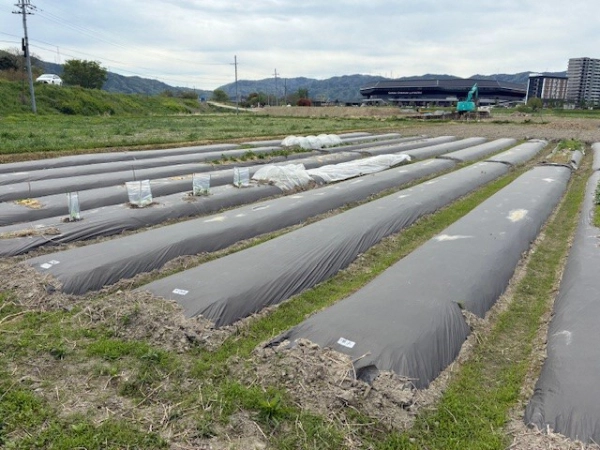
Conventional agricultural mulch sheets made of polyethylene have major environmental and operational challenges for farmers. Removing used plastic sheets, cleaning embedded mud, and paying industrial waste disposal fees demand substantial physical labour and financial resources. Furthermore, intense heatwaves during recent summers have caused soil temperatures to spike, leading to root rot and leaf scorch. The wood cellulose-based paper sheet, branded as OJI Sustena Mulch, addresses these issues through evaporative cooling. Water evaporating from the paper lowers peak soil temperatures by approximately five degrees Celsius compared to conventional black plastic mulch, helping protect crops from heat stress and boosting yields by up to 10 per cent.
The paper material also simplifies post-harvest operations. Farmers till the sheets directly into the soil after harvesting, where soil micro-organisms decompose the wood cellulose completely within a few months. This process eliminates post-harvest collection labour and industrial waste disposal costs. In addition, the paper’s natural breathability and water permeability prevent moisture and heat from accumulating beneath the sheet, reducing the risk of root decay and fungal infections. The sheet also provides a physical barrier against mud splash caused by rain, reducing soil-borne infections on young leaves, while blocking sunlight to suppress weed growth. Unlike conventional plastic-based biodegradable films, the paper sheets can be stored in dry conditions for two to four years without deteriorating, allowing flexible management across seasons.
Having issued Japan’s second Organic Village Declaration in February 2023, the municipality continues to promote public-private partnerships aimed at reducing plastic reliance and preserving local satoyama ecosystems, with continual innovations like the paper mulch project.
[Reference] PR Times (Japanese)