 Zenbird Editorial Team
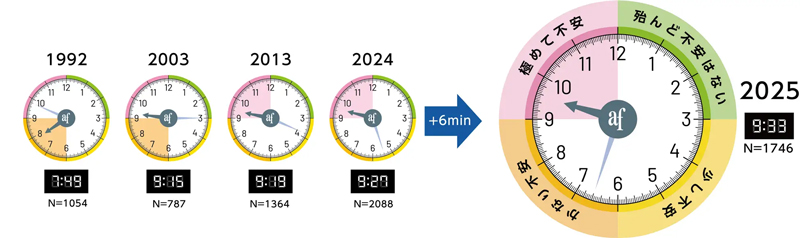
The Asahi Glass Foundation announced on 10 September the results of its 34th annual environmental survey, revealing that its symbolic Environmental Doomsday Clock has advanced by six minutes to 9:33. The survey, which polled 1,751 experts from 121 countries, indicates a heightened sense of crisis regarding the planet’s health for the first time in five years.
The Environmental Doomsday Clock a symbolic gauge created by the Asahi Glass Foundation that converts experts’ perceived urgency about global environmental risks into a “clock time,” where later times mean greater crisis. The time is reset annually from an international survey to track changes across regions and issues like climate change and biodiversity.
The six-minute jump marks the first time the clock’s hands have moved forward since 2021, ending a four-year period of slight retreat. It is the most significant single-year advance since 2017. The sense of urgency was particularly pronounced in the Middle East, where the clock jumped forward by 34 minutes, followed by Oceania with a 23-minute advance. In Japan, the time moved forward by two minutes to 9:39.
For the eighth consecutive year, “Climate Change” was the most cited issue influencing the experts’ sense of crisis. It was followed by “Biosphere Integrity (Biodiversity).” When ranked by the level of perceived crisis, biodiversity was considered the most critical issue, with an equivalent clock time of 9:50, ahead of climate change at 9:39.
The survey also highlighted a disparity in perceived progress between climate action and nature conservation. Respondents indicated that the “transition to a decarbonised society” was advancing more than the “conservation and restoration of wildlife habitats.” Experts believe progress on habitat protection is lagging significantly.
Regarding the United Nations’ Sustainable Development Goals (SDGs), the experts estimated an average achievement rate of just 33.7 per cent as of 2025. A notable 14.1 per cent of respondents felt the achievement level was zero. The goals considered least likely to be met by 2030 were “No Poverty,” “Reduced Inequalities,” and “Peace, Justice and Strong Institutions.”
When asked which actors are most crucial for solving environmental problems, a majority of respondents across all regions pointed to central governments. However, a gap in perception emerged among different sectors. While 51 per cent of corporate respondents stated that action by central or local governments was most important, only 27 per cent of respondents from central governments identified their own institutions as the key actors.
The full report from the 34th Questionnaire on Environmental Problems and the Survival of Humankind is available on The Asahi Glass Foundation’s website.
[Website] The Environmental Doomsday Clock[Reference] Asahi Glass Foundation News