 Zenbird Editorial Team
Tokyo-based technology start-up, EII, Inc., will accelerate the development of its next-generation AI recycling robots after securing significant government backing. The company expects to receive approximately 1 billion yen in new public funding over the next three fiscal years, bringing the project’s total government support to over 1.5 billion yen. Total investment in the venture is now projected to exceed 2 billion yen.
EII states the project has three primary goals: to establish innovative core AI robot technology for recycling plants, to promote a digital shift in the industry and contribute to the circular economy, and to improve working conditions by freeing human workers from repetitive manual sorting tasks.
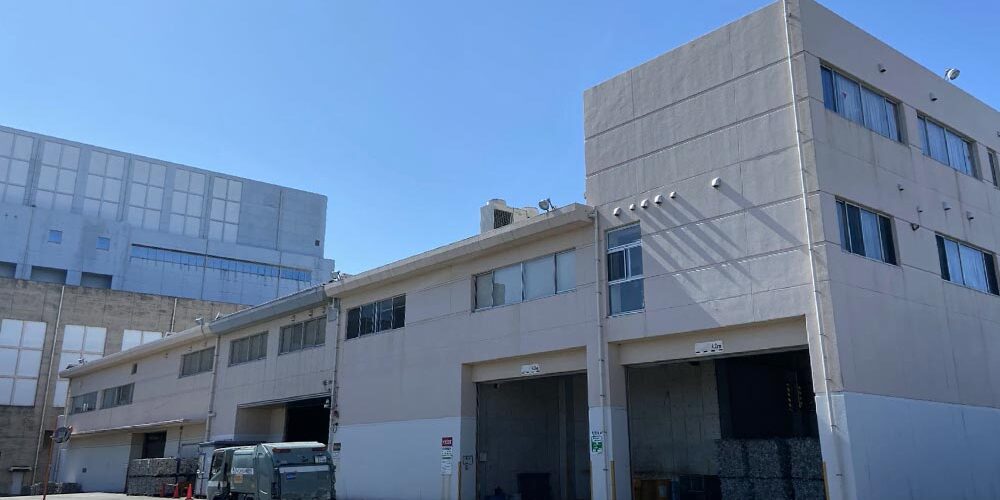
A key component of the initiative will be a three-year pilot project at the Kanazawa Resource Sorting Centre in Yokohama, scheduled to run from 2025 to 2027. An industrial parallel link robot, powered by EII’s proprietary LMM image recognition system, RecycleMind, will be installed to sort materials. The system will identify and separate glass bottles by colour, aluminium and steel cans, and various types of PET bottles, aiming for an image recognition accuracy of over 98%.
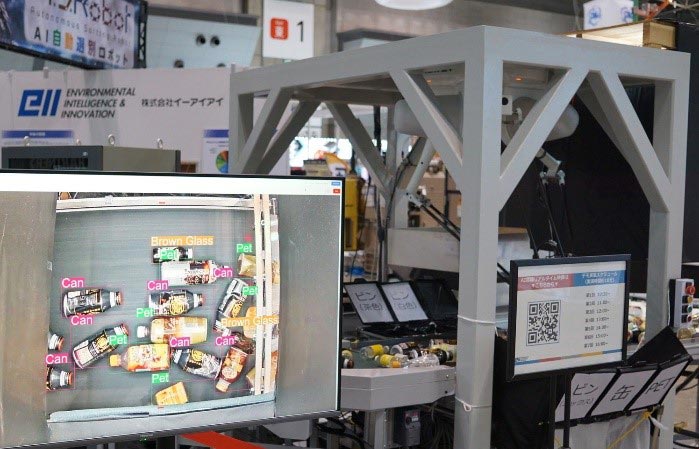
The company is also advancing research into more complex automation using Vision-Language-Action (VLA) technology. This will enable robots to perform delicate tasks such as removing caps and labels from bottles, emptying residual liquids, and sorting small electronics like lithium-ion batteries. This advanced capability is being developed using sophisticated 7-axis and two-armed collaborative robots.
To support this expansion, EII has established a new branch and manufacturing base in Iwaki City, Fukushima Prefecture, following a partnership agreement signed in March 2025. In collaboration with local businesses, the company plans to apply its technology not only to recycling but also to other industrial sectors, including manufacturing and nuclear decommissioning.
The development of these “Physical AI” systems, which can see, understand, and act in the physical world, pushes towards automating complex manual labour, and creates a more efficient and precise recycling process.
[Reference] EII Inc. News Release (Japanese)