 Roger Ong
“I vividly remember picking up a book in a bookstore, titled ‘Revolution in Ecological Materials,’ authored by Professor Ryoichi Yamamoto from the University of Tokyo. I was struck by the message that the Earth was in danger and that a future was approaching where materials would no longer be freely available. I showed it to my friends, and we had a lengthy discussion about it that night. That book made me realise that the planet itself was in danger.”
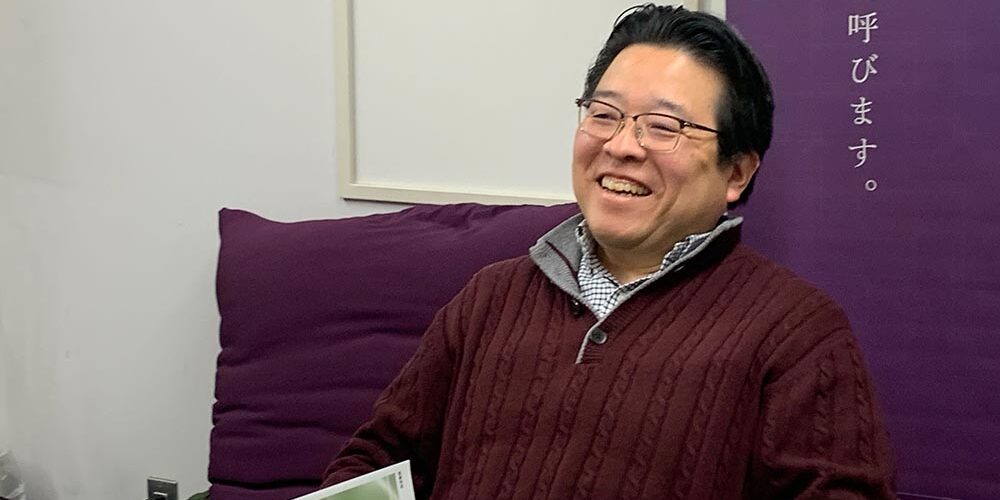
That was the moment that Ryuzo Furukawa started on his path of sustainability. Choosing to enter environmental studies over his initial interest in the space industry, the professor eventually found his way to Tohoku University, where he began a search to design sustainable lifestyles. And that was the beginning of the 90-Year-Old Interviews, a series of interviews that reveals how we can design sustainable lifestyles that coexist with nature, and perhaps even how humanity can return from our path so strayed.
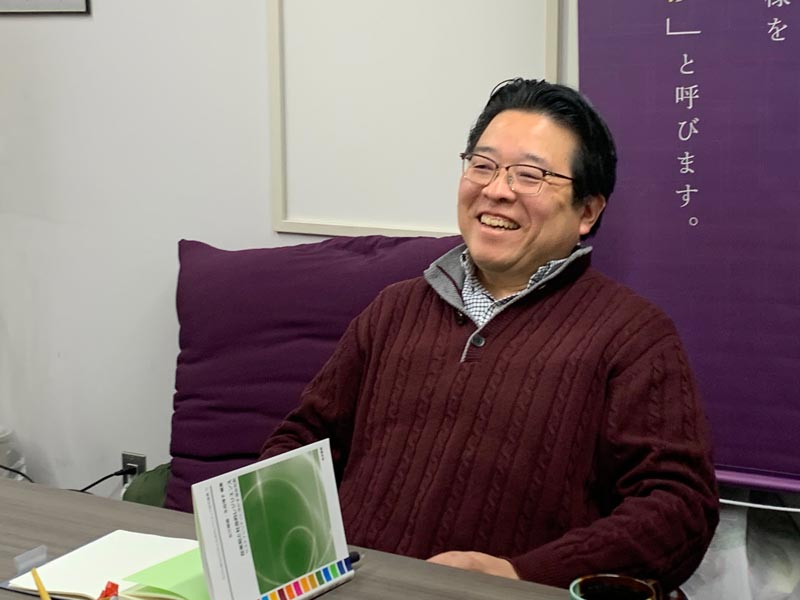
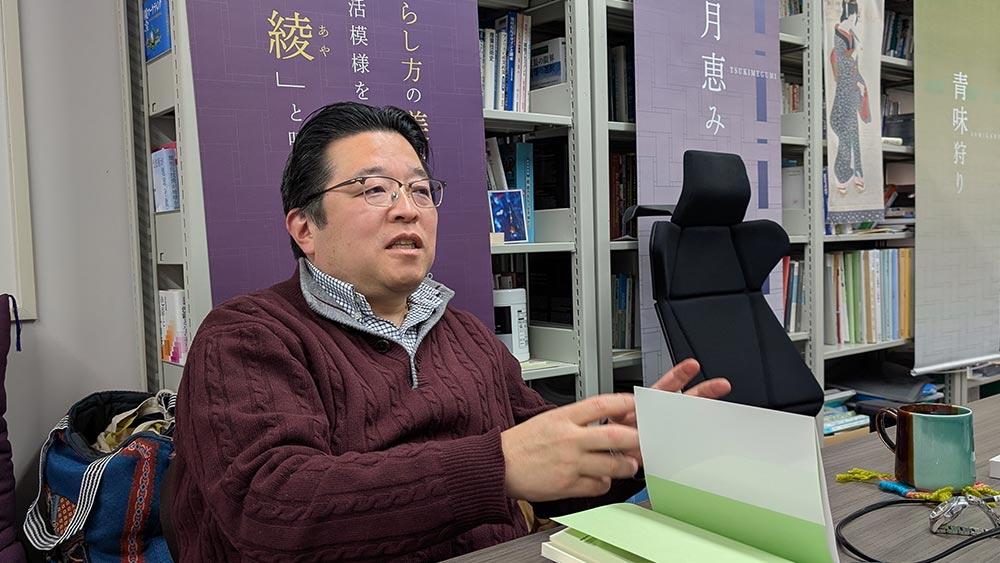
We sat down with Professor Furukawa at his current office at the Faculty of Environmental Studies, Tokyo City University, along with Special Research Fellow, Ayami Tamura, as we dove into learning about what goes into designing a sustainable lifestyle. We learnt about the “90-Year-Old Interviews” Project, “44 Values from a Disappearing Way of Life in Japan”, and their current projects that are helping others connect with a sustainable way of life.
On the quest to design a sustainable lifestyle
Furukawa understood throughout his research that transforming lifestyles was essential for sustainability. But creating change was not as straightforward.
Furukawa: “Designing sustainable lifestyles proved to be extremely challenging. While popular concepts like local production for local consumption and car-sharing were already established, these alone were not sufficient. There was a need to develop many more sustainable lifestyle models.
“Back then, many environmental scholars insisted on the importance of backcasting, working backward from a desired future scenario rather than predicting the future based on current trends. However, very few researchers were actually applying the methodology. That’s when I had the idea of using backcasting for lifestyle design.”
After a number of attempts to design new lifestyles, one of the students shared a story they had heard from their grandmother, describing a way of life before the Pacific War that felt like an entirely different world, and an even more enjoyable one. At the time, his grandmother was over 90 years old. This led to the idea of conducting more interviews, and this method later came to be known as the “90-Year-Old Interviews.”
90-Year-Old Interviews and the 44 Values from a Disappearing Way of Life in Japan
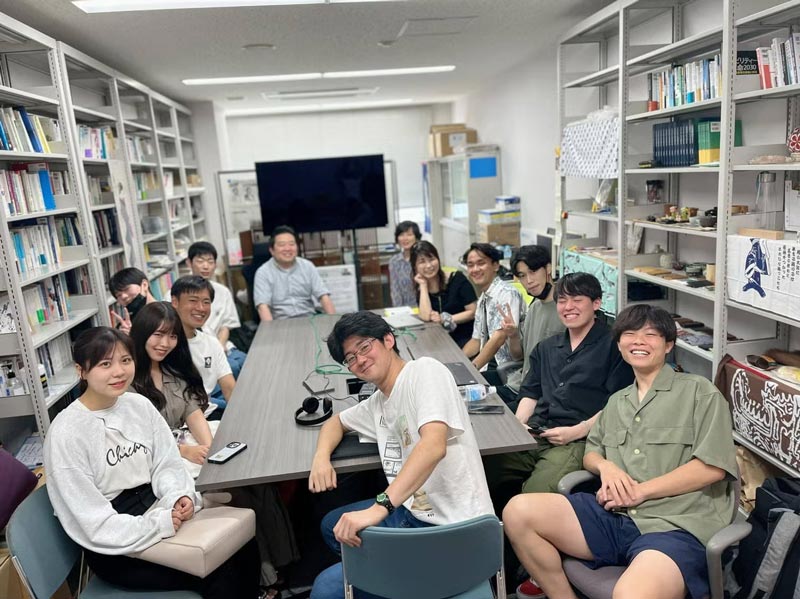
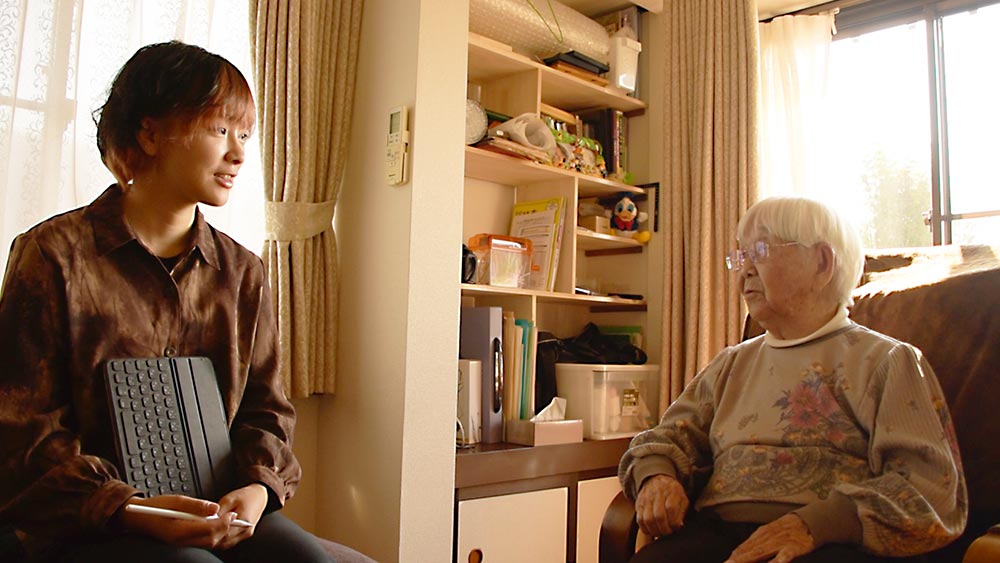
To find people around the age of 90, Furukawa’s team reached out to elderly acquaintances. They visited homes and conducted interviews, setting a time limit of two hours per person. “90-Year-Old Interviews” began in the winter of 2008 and has continued ever since.
Furukawa: “The findings revealed that before the introduction of modern conveniences, there were 44 distinct values that shaped daily lifestyle. However, as society shifted toward prioritising convenience, these values gradually faded.
“I remember that about two days before the Great East Japan Earthquake on March 11, 2011. At that time, we were focusing solely on Miyagi Prefecture, and in the process of analyzing around 100 common aspects of pre-war lifestyles, which later became the foundation for the ‘44 Values from a Disappearing Way of Life in Japan’.”
On the first reading of “44 Values from a Disappearing Way of Life in Japan,” it stuns. It does so not because there is some revolutionary idea or protocol to achieve sustainability. These 44 values reveal themselves like a perspicuous solution to our environmental and social problems. These values stun us, because of how surprisingly accessible they are to everyone, and because it disquiets us to the fact that we are losing these values and the sustainable lifestyle born from them.
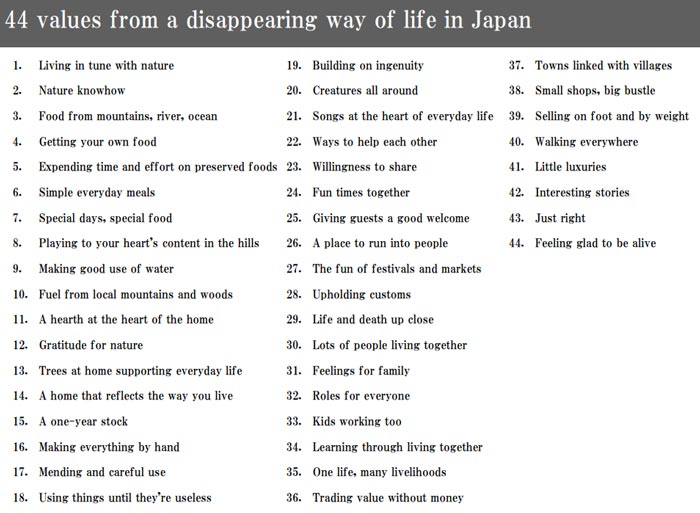
The 44 values include environmental and social aspects, hinting at how to live sustainably at home, how to live harmoniously with our community, and how to coexist with nature. A few of the values we are familiar with, like enjoying nature and the spirit of sharing. Some are a good reminder, like the importance of festivals and establishing a rhythm of life. Others can be surprising, like living close to life and death (to appreciate the preciousness of life) and letting children work (to communicate wisdom).
Furukawa’s research has garnered academic interest, gained recognition from government offices, and received gratitude from both the 90-year-olds interviewees and their families. Such studies are rare, possessing a remarkable quality that faces no disagreement from anyone. It has since expanded nationwide and even internationally, with a compilation book in the works.
90-Year-Old Interviews is intuitive and accepted
The purpose of “90-Year-Old Interviews” is to uncover the wisdom of the elderly that would form the foundation for designing sustainable lifestyles. It turns out that these interviews are also a powerful tool to get introduced into the communities the research team were visiting.
Furukawa: “In the field of environmental studies, we are always doing new things, like lifestyle transformation, lifestyle design, and sustainability-focused interviews. So, when we introduce a concept like “backcasting”, for example, people don’t always understand it immediately, so there’s some resistance. Many react with confusion, saying, “I don’t get it.” They assume the goal of our research is just to make life more convenient.
“But with the ‘90-Year-Old Interviews,’ people readily offered their help: ‘I know a 90-year-old who would be perfect for this!’ Once we begin learning from them and using their past experiences to shape future lifestyles, people start to feel reassured.
Furukawa reminded us that in many cultures (not just Japan), there is a longstanding tradition of respecting elders and ancestors. Even today, that sentiment remains strong. And this project creates gratitude in both the team and the families of these 90-year-olds.
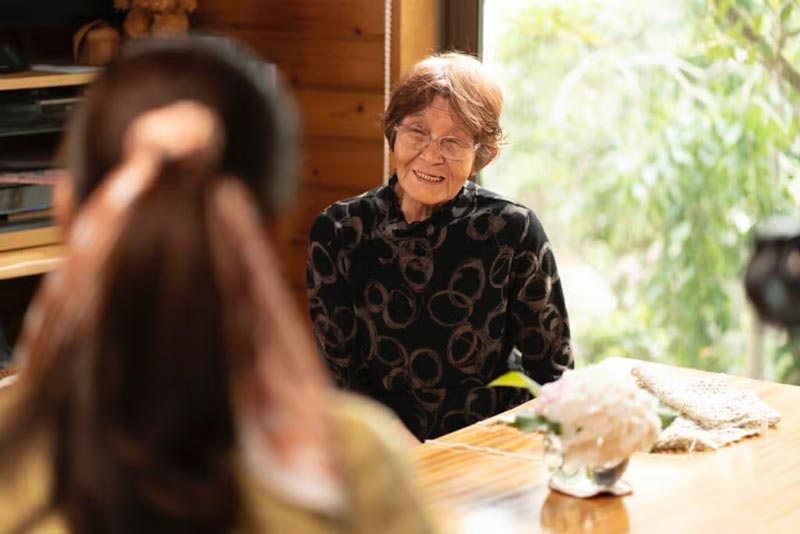
Furukawa: “Many 90-year-olds didn’t have many opportunities to tell their stories, so when I visited and simply heard them out, they were deeply grateful. I’ve come to realise that people feel a little shy about sharing their old stories with family members. [Not sharing] could mean valuable knowledge ends up being lost.
“The 90-year-old interviewees expressed their gratitude, simply because someone took the time to hear them out. Not only that, family members were listening in from behind a sliding door or in another room, and asked me for the recordings or tapes afterwards. And when new stories emerge, stories the family has never heard before, they exclaim how they have never heard them before. The family expressed their thanks, too.”
Different nuanced values because of different environments
The 44 Values from a Disappearing Way of Life in Japan are generally shared between the 90-Year-Olds, regardless where they come from in Japan. That also means that since each region has its own culture and customs, there are going to be slight differences. Furukawa’s team discovered that the specifics of daily life differed in relation to the environment.
Furukawa: “While it’s great that the 44 values serve as a unifying framework, they are ultimately abstract concepts. To truly design a lifestyle, we need to closely examine the specific way of life in each region, especially its relationship with the natural environment. For example, cold and hot regions have entirely different diets, different fruits growing naturally, different ways of dealing with strong winds, humidity, and so on. All of these environmental factors shape daily life in a particular way.
“That’s why, when implementing projects at the regional level, we rely on 90-year-olds from that specific area. Their words carry a lot of weight. However, we still use the 44 values as a reference. Through interviews, we start to see commonalities and differences emerge across different regions.”
The difference is the same when comparing Japan with other countries. For the Japanese-English translation of the 44 values, the translator pointed out that there were no direct English equivalents for some of the concepts. He had to interpret them rather than translate them literally.
Furukawa: “This highlights the difference in conceptual frameworks between languages. Some cultures also instinctively reject foreign concepts. They don’t want to adopt ideas from outside unless they align with their own identity. This isn’t unique to foreign countries; it happens in Japan too. For example, if someone from Miyagi Prefecture were to say, ‘This is the way things should be,’ people from other prefectures might not accept it. But if a 90-year-old from Shizuoka Prefecture shares something, people from Shizuoka would be more likely to embrace it.”
Ultimately, our values are shaped by nature
Despite the small deviations, it seems that there is one unifying element: our values are shaped by how we interact with our surrounding nature.
Furukawa: “I initially thought that Japan would have vastly different values from other countries, so I went overseas to conduct interviews. I’ve also been asked general questions about whether differences in religious beliefs lead to differences in values. But they actually don’t.
“Fundamentally, values are the same and consistent. What differs is the climate, the surrounding nature, plants, and animals. In ancient times, regardless of what religion people followed, they all had to consider how to live within their natural environment. That’s why their way of life was the same. Even if we people of different religions in the same Japanese natural environment, would have to adopt the same lifestyle in order to survive.”
During our discussions, we explored terms that seemed to originate from Japan, but are actually shared values across the world. For example, the sense of mottainai (an aversion to waste) is a common mindset of people who live in environments with scarce resources, as they naturally develop a mindset of treasuring what they have. Festivals, too, which Furukawa’s team found to be an ideal lifestyle. No matter the country, people gather to celebrate and feast, with its community members playing a role in organising festivals. Such are values that we share across different cultures, and nature binds us all.
Backcasting in designing sustainable lifestyles – from constraints, come innovation
We mentioned backcasting, which is a crucial part of the research on designing sustainable lifestyles. Understanding backcasting means to understand how constraints and innovation go hand in hand, and it’s exactly what we see in the 44 values.
Furukawa: “Backcasting is a thought process that embraces constraints and generates new value within those limitations. It is fundamentally a Japanese way of thinking: accepting circumstances and then finding ways to make the most of them.
“However, there was a gap in existing backcasting studies. Western concept of backcasting focuses on setting future goals and then working backwards to determine the necessary steps. However, in many of these research papers, the process of defining the future vision is often vague. The key question is: who defines the future?
“Many Western approaches assume a predetermined goal, often relying on existing frameworks like local production for local consumption. However, if the goal itself is flawed, then the entire journey becomes misguided. The Western approach to backcasting often fails to address this crucial step of how to properly define the goal. Recognising this gap, I merged the concepts of backcasting and lifestyle design to create a new research approach.”
One thing that stood out from the research was how the Japanese accepted constraints as they were.
Furukawa: “I found inspiration from people in their 90s. They embodied the backcasting mindset without even realising it. Instead of lamenting what they lack, they creatively find joy within their limitations. Their way of thinking is, ‘If we don’t have something, we just have to come up with a new way to enjoy life’. It became a key insight for me.
“In the past, many people naturally held this belief. We are alive because nature sustains us. The sun shines, allowing food to grow. If nature ceases to provide for us, we cannot survive. It’s not about humans simply ‘being alive,’ but rather about ‘being sustained by nature,’ which in turn fosters a sense of duty to fulfill some role in life.
“Ultimately, backcasting is about understanding future constraints and then finding ways to enjoy life within those conditions. Elderly individuals have already mastered this way of thinking. Their ability to generate innovative ideas stems from a lifetime of adapting to limitations.”
Beyond 90-Year-Old Interviews and the 44 Values
Very often, talking about sustainability will involve less intuitive concepts, which require time and effort to understand. Terms like bioeconomy, circular design, and decoupling are not the friendliest to grasp. But thanks to Furukawa’s research, we now have a set of simple values that people can get behind, and a way to hone them to local relevance.
This is just the beginning, as Furukawa plans to further make these learnings useful and applicable. He and his team already apply the knowledge to various local projects, and are now taking steps further to inspire others in newer projects, even creating personal investment in sustainability, which is essential for motivation for sustainable actions.
Kurashikata no Aya: Beauty in sustainability
One such project is Kurashikata no Aya, which means “Intricate Weave of Lifestyle”. Through conducting the 90-year-old Interviews, Furukawa’s team has seen various forms of beauty, including nature, gestures, thoughtfulness and lifestyle. This platform is designed to convey that beauty.
The words on Kurashikata no Aya are enthralling, each designed to convey a memory from the 90-year-old through the beauty of sound and imagery. Ayami Tamura is a Special Research Fellow working with Professor Furukawa to bring the project vision to life.
Tamura: “[Most of] the words in Kurashikata no Aya are conceived and developed by me. As Professor Furukawa mentioned earlier, the words spoken by the 90-year-olds are quite long, so I aimed for concise phrases that effectively convey the essence of that concept. While some words already existed, about 80% of them needed new words.
“For example, 藍映し (ai utsushi) is a phrase that refers to the reflection of indigo dye in the river. The town where indigo dyeing flourished had many rivers, and the scenery was often characterised by these reflections. To capture this imagery succinctly, I coined the term ‘Indigo Reflection’.”
View this post on Instagram
The strength of these Aya Words lies in the sense of familial identity. Instead of emphasising themes like the environment or sustainability, these words evoke beauty, trigger vivid imagery, and a desire (or even longing!) to visit certain places. These words are able to create an emotional connection.
However, it isn’t the beauty of words or memories this project wants to share, but the Aya (or weave) of lifestyles. Aya refers to the elegant weaving of patterns in textile. In Aya Words, we feel the profound weaving of beauty of words, the memories of 90-year-olds, sustainable lifestyles connected to nature and more.
Tamura: “Rather than spreading the beauty of a particular way of life or having people learn the words, I want to share the Aya itself. I want to highlight things that are close to us, like wisdom from 90-year-olds.
“I see these Aya Words taking on a role similar to proverbs or four-character idioms. There are times when people look for guiding words to help them navigate certain situations. I hope Aya words can become a source of wisdom. If these words can become a source of support for people’s lifestyles, that would be wonderful. That’s why I feel a strong urge to create these words.
“The beauty of living is something that still exists everywhere if we just look for it. It doesn’t have to come from our mothers; we can learn from small things, too. I hope that people will start recognising that beauty in their everyday lives through the ideas in Kurashikata no Aya.”
Askazi: Casual sustainability that promotes creativity
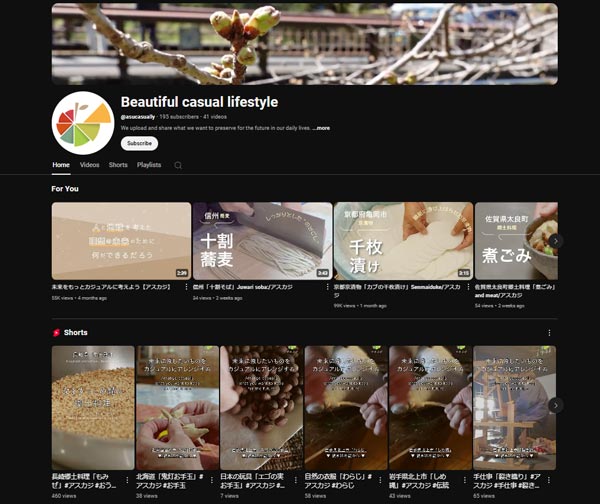
Another project that Furukawa shared with us is “Askazi,” aimed at sharing insights of local cultures and craftsmanship and making them accessible to all.
The concept of Askazi is rooted in “mingei”. Mingei refers to Japanese folk crafts crafted by the common folk through traditional techniques. They can include woodwork, pottery, or textiles. The term was popularised by Yanagi Soetsu in the early 20th century, who found appreciation in the honest beauty of everyday objects made by unknown artisans. Furukawa wants to communicate and make accessible the beauty that is found in the way of life from mingei.
Furukawa: “Askazi encourages behavioral change. This connects to the key values of ingenuity and adaptation. In the past, Japanese people constantly devised ways to create things. It is unlike today where we are accustomed to getting things pre-made, which also means there is no opportunity to experiment. Many of Japan’s most beautiful things, including crafts and cuisine, are the result of artisans refining their techniques over time. Cooking is no different. If more people embrace this spirit of ingenuity, they can transform seemingly difficult recipes or lifestyles into something personal and achievable through their own adaptations.”
You can find videos on its YouTube channel, which have explanations in English. It has a number of videos about traditional cooking and recipes, too. Furukawa encourages active engagement, which is what he does when sharing the concepts with his students.
Furukawa: “When we give students assignments related to this, they often explore local cuisine from their hometowns and share their own attempts at recreating traditional dishes. This fosters new cultural expressions and innovative ways of making things. We want to organise more workshops and increase the number of instructors who can teach these techniques, so we can foster a greater appreciation for craftsmanship and traditional ways of living.”
Editor’s Note
These 44 values from a Disappearing Way of Life in Japan are a gift from those who lived before the era of convenience. Too excited by the lure of convenience, we have forgotten to treasure things like communal activities to strengthen human bonds and gratitude for nature. We should not let these values disappear.
As we wrapped up the interview, I was reminded again of how traditional wisdom can provide answers to some of the dire problems we face today. The world faces constant instability and threats socially and environmentally. Some start giving in to the mindsets of collapse and doomerism, only because we don’t have an answer to “what we can do” in the seemingly inevitable crises.
While we have heroes doing the heavy lifting by advocating for system change (and they’ll still need our support), we should not feel helpless. We can start with these 44 values as a guide, rediscovering our link with nature and looking out for one another in your community. Furthermore, these values can offer insights into how businesses and organisations can help increase sustainability in our local regions.
[Website] Ryuzo Furukawa Laboratory Homepage[Reference] “90-Year-Old Interviews” (Japanese)
[Website] Kurashikata no Aya (Japanese)
[YouTube] Askazi – Beautiful casual lifestyle