 Zenbird Editorial Team
ー Sponsored by the City of Yokohama ー
Cities in Asia-Pacific are now engines of economic growth. At the same time, they are where serious challenges concentrate: rising resource consumption, growing volumes of waste, environmental degradation and climate change. How can cities keep growing and prospering while using fewer resources, minimising waste, and becoming more resilient? This is a pressing question that cities today must confront.
The key to answering it lies in the transition to a circular economy. This means going beyond waste management and recycling to fundamentally rethink how materials are designed, produced, consumed and recovered, and to turn environmental challenges into opportunities for innovation and jobs.
This report covers a session at the Asia-Pacific Circular Cities Forum (APCC-Forum) titled “City to City Session: Signatory Cities of the Asian Circular Cities Declaration (ACCD) and International Organizations Discuss Scaling the Circular Economy through Intercity Collaboration.” Drawing on the concrete initiatives shared by Bangkok, Makassar and Cebu, supported by the Japan International Cooperation Agency (JICA), the City of Yokohama, and others, together with the perspectives of development partners such as the Asian Development Bank Institute (ADBI) and JICA, we get to the heart of how intercity collaboration advances the circular economy.
Strengthening resilience through intercity collaboration
Opening the session, Makoto Kato, Board Member of the Overseas Environmental Cooperation Center, Japan (OECC), explained its purpose. He stressed that for Asia-Pacific cities facing rising resource consumption, climate change, and other serious challenges, the transition to a circular economy is essential if they are to stay resilient while continuing to grow and prosper.
Kato: “The circular economy is not just about waste management and recycling. It is about fundamentally rethinking how resources are designed, produced, consumed, and recovered. We need to turn environmental challenges into opportunities for innovation and employment.”
Partnerships have been built between Japanese cities such as Yokohama and cities in ASEAN countries, with the involvement of international organisations and development partners such as JICA and ADBI. A key theme running through the session was the idea of strengthening urban resilience more effectively and efficiently by building institutional frameworks and workable systems, rather than ending with one-off projects.
How intercity collaboration supports three cities’ visions
1. Bangkok Metropolitan Administration, Thailand: Zero carbon and the circular economy, starting from a master plan
Representing the Bangkok Metropolitan Administration was Rachada Maneewong, Director of the Waste Management Service Division, Solid Waste Management Strategy Office, Environment Department. Bangkok and Yokohama have worked together for many years. Under the City-to-City Collaboration Programme for Zero-Carbon Society, their cooperation has grown to include developing and implementing a climate change master plan, an energy action plan, and action plans for waste and wastewater.
Bangkok is now focused on speeding up its path to net-zero emissions by 2050, and the transition to a circular economy is part of that effort.
Maneewong: “Our efforts start with reducing waste and separating it at source. From there, we extend to recycling, resource recovery, making use of organic waste, and generating energy from waste.”
Specifically, the city has launched the No-Mix Waste project and the BKK WASTE PAY app. Using a digital platform and financial incentives, these initiatives encourage households to separate valuable materials such as plastic, metal, paper and glass at source for collection. Organic waste is turned into compost and biogas, while waste that is hard to recycle is used to generate power. Through these measures, Bangkok aims to reduce both the amount of waste sent to landfill and greenhouse gas emissions.
2. Makassar, Indonesia: Advancing the circular economy by drawing on shared traits as waterfront cities
Makassar sits at the centre of Indonesia and serves as a logistics hub for the country’s eastern region. It is a maritime city of 1.5 million people with an economic growth rate of 6.61%. But rapid urbanisation has brought urgent challenges, including urban flooding, rising waste volumes, and a high non-revenue water rate (the proportion of water that earns no revenue because of leaks and other losses) caused by ageing water management systems.
According to Andi Zulfitra Dianta, Head of the Cooperation Office of the City of Makassar, the city is tackling these challenges through a partnership with Yokohama, which shares many traits with Makassar as a maritime city and logistics hub. A distinctive feature of Makassar’s approach is that it also works with Maniwa City in Okayama Prefecture and Kawasaki City in Kanagawa Prefecture on the circular economy, water management, and flood control.
Dianta: “In addressing complex urban challenges, international intercity collaboration brings three benefits: the exchange of knowledge and technology, access to joint financing opportunities, and the creation of new commercial markets, trade opportunities, and cultural ties.”
Through its partnership with Yokohama, Makassar has carried out studies on installing solar power at battery-swapping stations for electric motorcycles and on introducing battery-swapping electric buses, and is making arrangements for a pilot to introduce refuse collection trucks with advanced cleaning functions. Dianta said that by sharing innovation through intercity collaboration, securing alternative funding, and overcoming challenges together, cities can accelerate the transition to a circular economy.
3. Cebu City, Philippines: The “Rising Above Waste” Project as a response to crisis
Cebu City, home to about 1.2 million people, has relied on landfills for the 600 to 700 tonnes of waste it generates each day for the past 25 years. But after a series of disasters such as earthquakes, typhoons, and a landfill collapse, the city became keenly aware of the limits of its landfill-dependent model, which costs a great deal (about 2 million pesos, or roughly 5 million yen, per day).
In response, Cebu City Mayor Nestor Dionson Archival has been promoting the “Rising Above Waste” project.
Mayor Archival: “We need to change the way we think. The old way is not sustainable, and it keeps costing us a lot of money every day. That’s why we are working to divert waste away from the landfill, separating it first and sending it to eco-stations.”
Of Cebu City’s roughly 80 barangays (the smallest administrative unit in the Philippines), 25 barangays have already started separating waste at source. With students and residents involved, the city uses a black soldier fly bioeconomy model, feeding collected biodegradable waste to larvae, which are then turned into poultry feed and organic fertiliser.
The city has also built systems to process collected PET bottles mechanically and reuse them as materials for moulding and processing, and to send single-use plastics to cement plants for use.
In addition, Cebu City has signed the ACCD, which Yokohama promotes as a founding city, and the mayor said the city will work towards its vision of becoming a sustainable, smart, and inclusive city by 2035.
The role of development partners in connecting and supporting cities
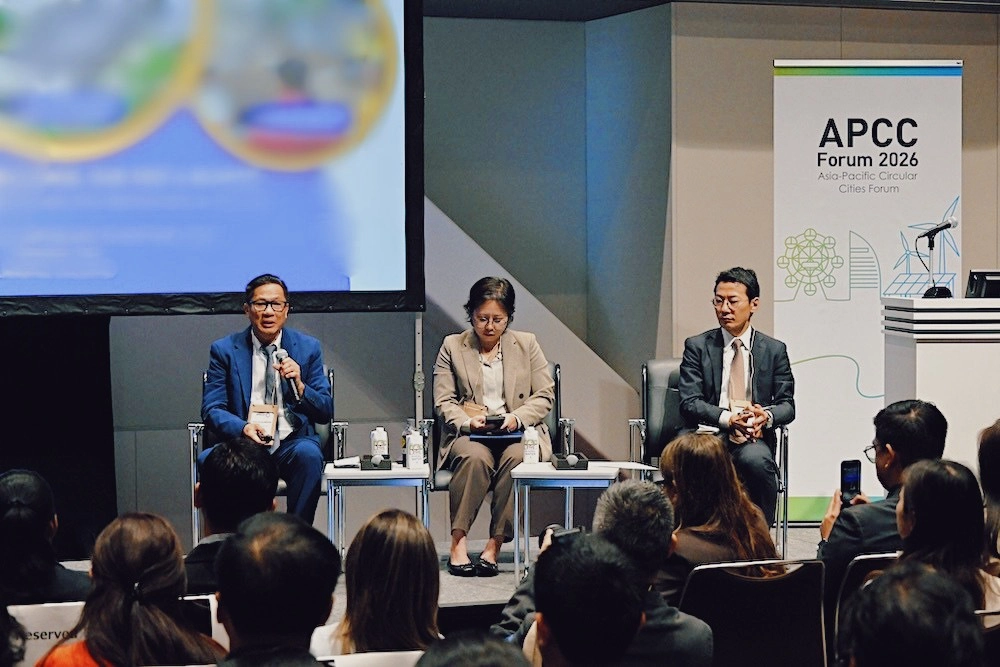
Next, Joy Blessilda Sinay, Capacity Building Specialist at the Asian Development Bank Institute (ADBI), introduced the institute’s capacity-building work, including training for policymakers and city officials and an open self-learning platform.
Sinay: “ADBI translates insights from the publications and case studies produced by our research department into our capacity-building programmes, supporting science- and evidence-based policymaking. Government budgets alone cannot meet the needs of infrastructure investment and the circular economy, so we also run programmes that bring in private-sector expertise, financial institutions, and philanthropic foundations.”
She also emphasised the importance of platforms that bring together a wide range of stakeholders, so that cities can learn from one another through intercity networks, sharing not only their successes but also their failures.
Shigehiko Sugita, Group Director of the Urban and Regional Development Group, Infrastructure Management Department, at the Japan International Cooperation Agency (JICA), pointed out that international cooperation has become more equal in recent years.
Sugita: “Since the adoption of the Sustainable Development Goals in 2015, international cooperation has shifted away from the old donor–recipient relationship, in which one country teaches and the other is taught, towards a more partnership-oriented approach. On the challenges that Japan and the Asia-Pacific region share, we want to support advanced solutions and work on them together as international partners.”
Sugita also praised intercity cooperation as a forum that creates a virtuous cycle, in which knowledge sharing between cities leads to mutual learning within the same region and on the same agendas. He then highlighted three key points:
- Human resource development: In addition to technical cooperation and hands-on knowledge sharing, encouraging the participation of younger generations and local leaders creates a resource that supports city-level cooperation.
- Collaboration with private companies: A strong foundation of intercity cooperation makes it possible for Japanese companies, universities, and public institutions to take part with confidence. The collaboration with Yokohama-based companies on electric buses in Makassar is an excellent model.
- Expanding regional networks: Now that, through years of intercity cooperation, former aid recipients have become partner countries, it is important to extend this experience to other cities across Asia-Pacific.
In closing, Sugita praised Bangkok for treating its climate change master plan not as a mere showpiece, but as a living document that guides daily practice with an eye to 2035. He added that the long history of cooperation built by Cebu City and other cities together with Yokohama and JICA, from developing master plans to managing waste and water resources, now provides a solid foundation for advancing the circular economy.
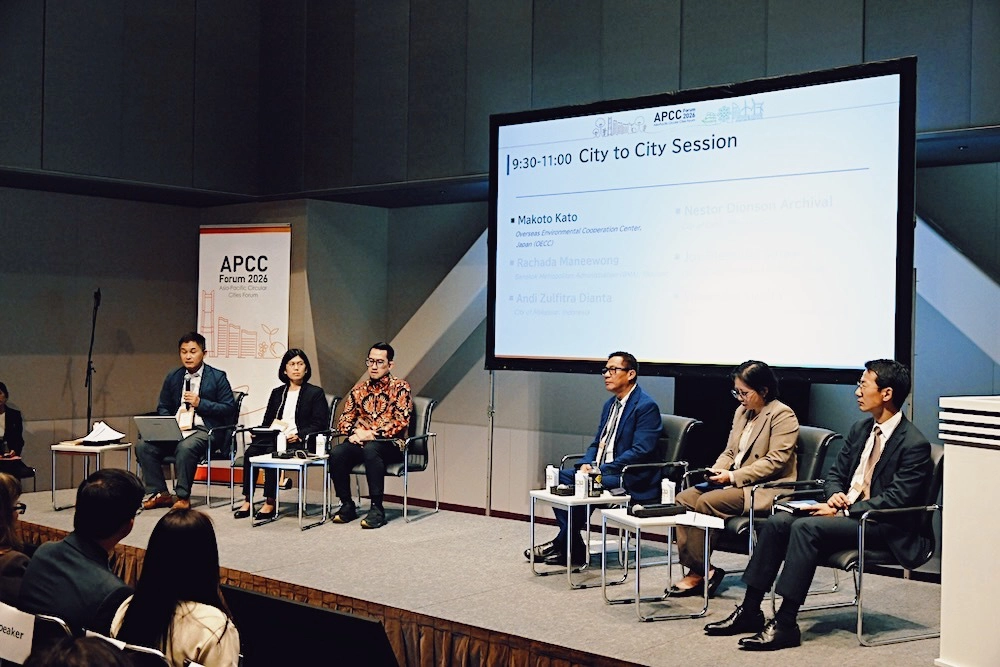
Panel discussion: From learning to co-creation, and on to practice
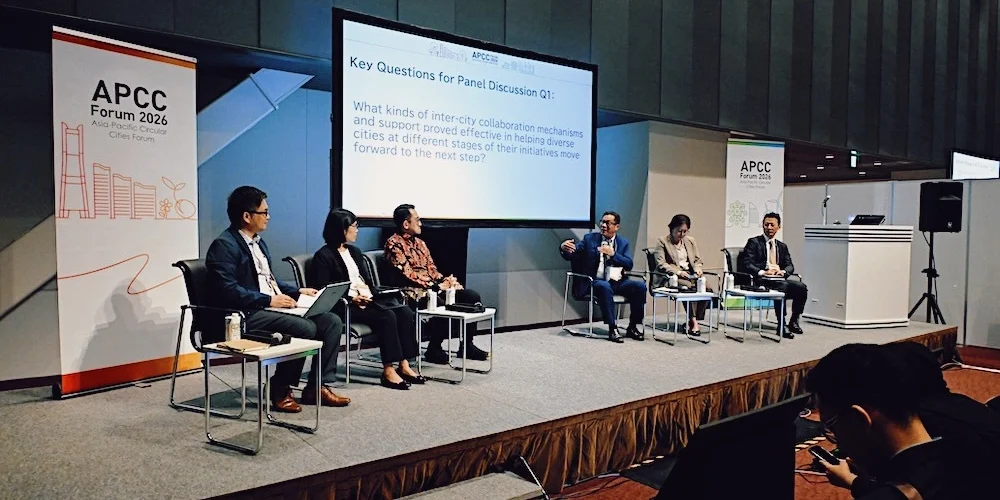
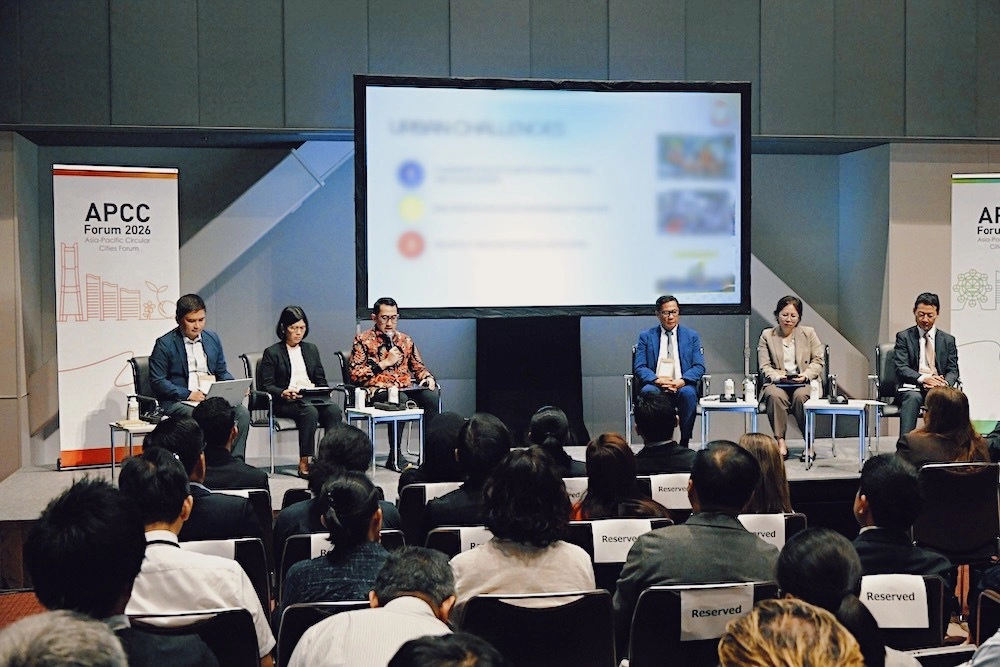
In the panel discussion, representatives of the three cities and the moderator discussed concrete approaches and challenges for taking intercity collaboration to the next level.
Archival of Cebu City named the biggest challenge to project continuity as the lack of sustainability that comes with changes in political leadership.
Archival: “It is very difficult to keep a project going after a mayor’s term ends. That is why we need ordinances and legislation that require the project to continue, so there is a mechanism to pass it on reliably to the next generation.”
Dianta of Makassar also pointed to the impact of changes in political leadership. He explained that the city is institutionalising its projects by making the office at the core of its cooperation a permanent unit, and is bringing local universities in as partners. This creates a structure that can keep going on its own even after support from donors and international organisations ends.
On how to make waste separation and other environmentally friendly behaviour stick, Archival stressed the importance of giving waste value and offering incentives. In Cebu City, drivers and workers on the trucks that collect separated waste receive incentives such as rice, and the city strictly refuses to collect unseparated waste. This firm approach on the ground has won residents’ cooperation.
It is also noted that for best practices from one city to be replicated and scaled elsewhere, results must be shared as verifiable data. Moderator Kato pointed to the potential of the Joint Crediting Mechanism (JCM), a bilateral crediting scheme that Japan has introduced with the Philippines and Thailand under Article 6.2 of the Paris Agreement. The discussion suggested that building systems to return carbon credit revenue to the people working to protect the environment could serve as an incentive for advancing the circular economy.
Scaling the circular economy in Asia-Pacific
This session showed that intercity collaboration can offer practical solutions to the environmental and climate challenges facing Asia-Pacific cities. Four key takeaways emerged from the discussion:
- From imitation to grounded, equal co-creation: Rather than copying other cities’ models as they are, cities need to create solutions together through pilot projects, adapted to each city’s local context, such as maritime location, climate risks, and fiscal size.
- Governance and institutionalisation to ensure continuity: To avoid being derailed by changes in political leadership, cities need to build initiatives into institutional frameworks, such as treating master plans as living documents and passing ordinances that require projects to continue.
- Incentive design and engagement of diverse stakeholders: Introducing economic and material incentives, such as systems that give waste value, to encourage behaviour change among residents, and building multilayered partnerships involving universities, private companies, and international organisations.
- Data-driven knowledge sharing and diversified finance: Using knowledge platforms to collect and share data on both successes and failures, and diversifying funding sources through private finance and mechanisms such as the JCM, rather than relying on public budgets alone.
The work that Bangkok, Makassar, Cebu and other cities have built up together with Yokohama and international organisations offers a clear guide for the future of the circular economy and sustainable urban development across Asia-Pacific.
Going forward, the key will be bringing together each partner’s knowledge and financial base, along with the practitioners and residents working on the ground, on the basis of equal partnerships that do not flow in only one direction. That may be the mechanism that allows Asian cities to turn the circular economy from an ideal into a practical reality.
Written by Natsuki Nakahara.
Originally published on Circular Economy Hub.