 Zenbird Editorial Team
ー Sponsored by the City of Yokohama ー
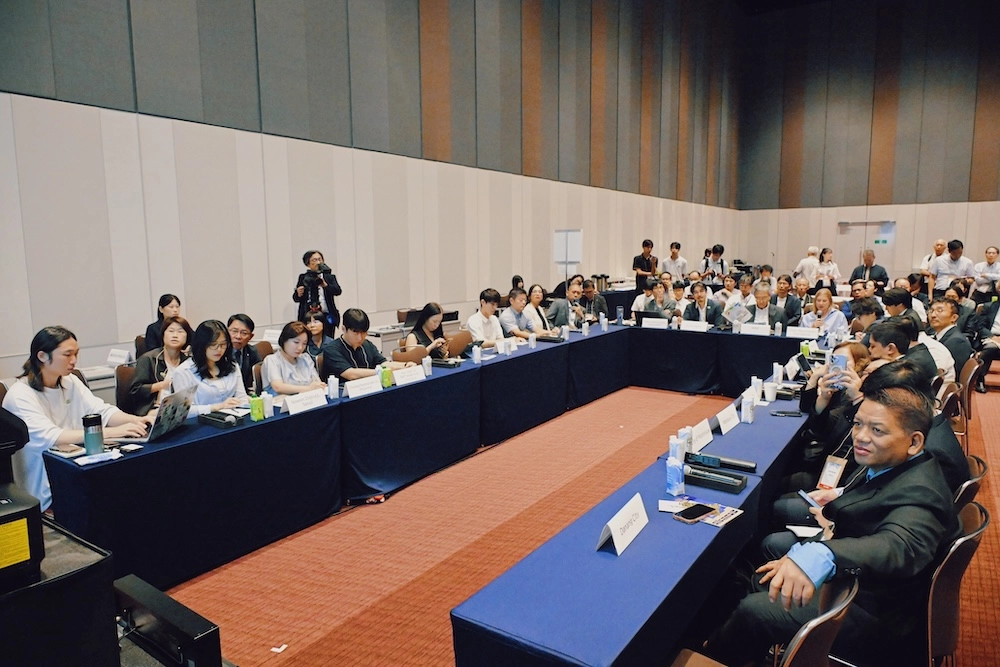
The Asia-Pacific Circular Cities Forum (APCC-Forum) was held at Pacifico Yokohama North on 3 and 4 September 2026. On the second day, the founding cities of the Asian Circular Cities Declaration (ACCD) gathered for the session “Plastic Pollution and Local Governments.” The session explored how the international community, national governments and the local governments on the front lines are tackling the growing problems of marine plastic pollution and waste.
The United Nations Intergovernmental Negotiating Committee (INC) is currently working to develop a legally binding global plastics treaty, but the road to consensus has been far from smooth. Against this backdrop, how are cities working to make plastics circular?
The session opened with an update on the latest treaty developments from the Institute for Global Environmental Strategies (IGES). The Ellen MacArthur Foundation, the Tokyo Metropolitan Government, and cities across Asia-Pacific then shared practical lessons from building systems that keep plastics in circulation. A lively discussion followed on how to close the gap between legislation and implementation on the ground.
Where international negotiations stand: The future of the Plastics Treaty and what it means for cities
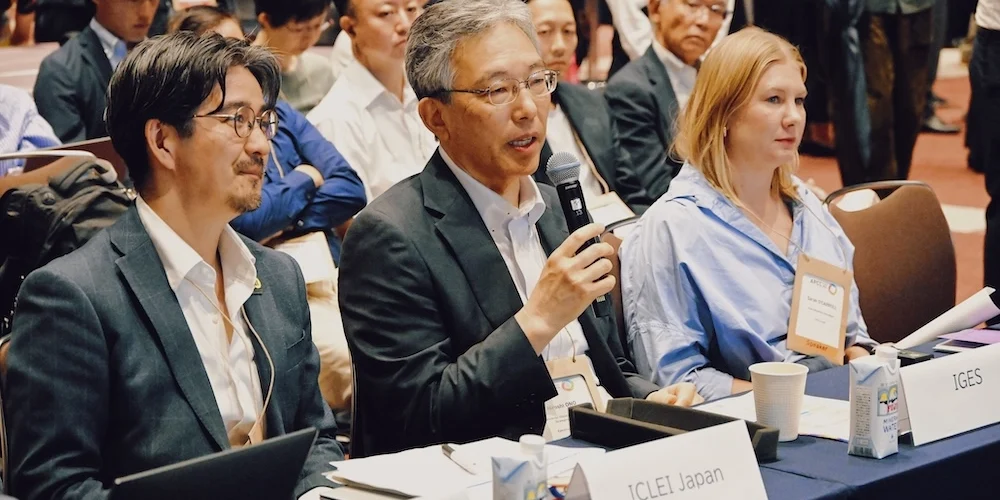
Opening the session, Hiroshi Ono, Executive Director of IGES, outlined the status of the plastics treaty negotiations under the INC, which have continued since the resumed fifth session of the UN Environment Assembly (UNEA-5.2).
Ono: “Plastic pollution is a global challenge that no country can solve on its own. But the discussions toward a treaty agreement have been extended, and the next INC session is scheduled for March 2027. Even if a treaty is agreed, it will take several more years to reach implementation, through a diplomatic conference, the ratification process and preparations for the first Conference of the Parties (COP1).”
Ono named two benefits a treaty would bring: harmonizing regulations that currently differ from country to country to create a level playing field for global companies, and encouraging the transition to a circular economy from production through consumption. At the same time, he pointed to challenges such as how to reflect the limitations on production and consumption in the treaty, and how to bridge the different starting points of each country.
He also noted that plastic pollution continues in the meantime. With the treaty still years away from being agreed and entering into force, pollution is getting worse every day. He made a strong case for local governments to lead the way: “Proactive, accelerated action by cities is essential. Concrete action on the ground gives national governments the confidence to negotiate from a stronger position and to ratify.”
Global frameworks and the need for a “common language”
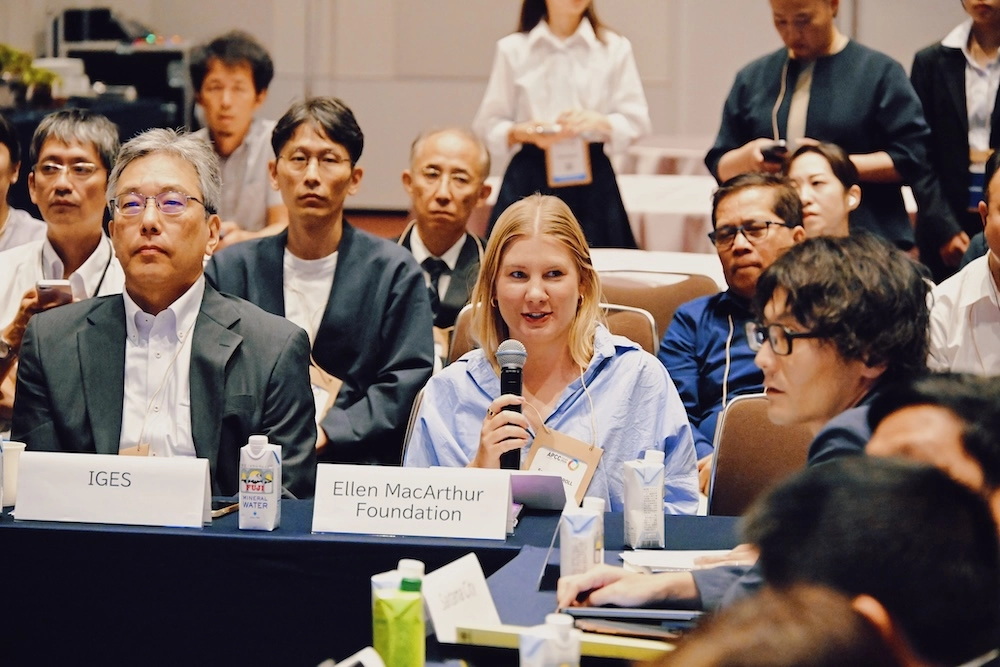
Next, Sarah O’Carroll, Institutions Lead at the Ellen MacArthur Foundation, spoke about international trends specific to plastics and how businesses and cities can work together.
In 2016, the Foundation published its projection that by 2050 there would be more plastic than fish in the ocean. In 2018, it launched the Global Commitment together with the UN Environment Programme (UNEP). Its signatories account for about 20% of the global plastic packaging market. Since 2018, they have avoided the use of about 14 million tonnes of virgin plastic, tripled recycled content, and removed 775,000 tonnes of problematic packaging from the market.
But O’Carroll pointed out that individual initiatives and voluntary targets can only go so far.
O’Carroll: “If voluntary shared targets and agreements have achieved this much, legally binding global obligations could take us even further. A patchwork of regulations that relies on each country’s own approach will only put companies that move first at a disadvantage and add complexity to global supply chains.”
The Foundation is calling for legally binding, globally harmonized requirements in four areas: minimizing plastic, reusing packaging, improving recycling, and increasing the use of recycled materials. O’Carroll also introduced pilot projects for reuse infrastructure in Jakarta, Indonesia, and Recife, Brazil. She stressed that hard-to-manage plastics, such as sachets and other flexible packaging, account for 80% of plastic entering the ocean, and that addressing this structural problem requires an approach that brings business, policy, and cities together.
Tokyo’s “carbon closed cycle” and reuse in office districts
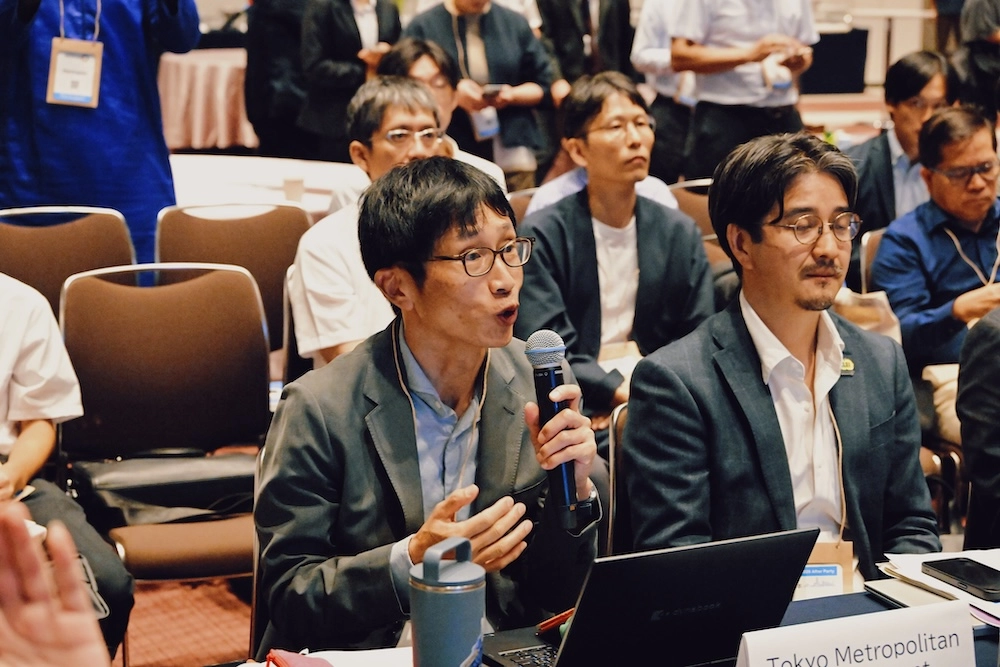
Presenting a leading local government example, Takanobu Iwasaki, Deputy Director for Planning at the Sustainable Material Management Division, Bureau of Environment, Tokyo Metropolitan Government, shared the specific challenges Tokyo faces and how it is addressing them.
To achieve net zero by 2050, Tokyo has set out a “carbon closed cycle” that keeps plastics in circulation. Its goal for 2030 is to cut plastic incineration from households and large office buildings by 40% compared with fiscal 2017, from about 700,000 tonnes to about 400,000 tonnes.
1. Supporting household waste separation
Separate collection of plastics has expanded from 34 of Tokyo’s 62 municipalities in 2019 to 48 in 2026 (the figures cover 53 municipalities, excluding nine island municipalities). Separation is also spreading in central Tokyo. Working with private companies, the metropolitan government has expanded systems to collect and recycle large plastic items, such as polypropylene storage cases (about 600,000 of which are discarded every year), from five municipalities to 20.
2. Barriers to reuse in office districts
In Tokyo, with its dense concentration of large buildings, reuse in offices, such as introducing reusable cups, is important. But the hurdles remain high: building the infrastructure needed to compete with the low cost and convenience of single-use items (networks for washing, transport and collection) and changing user behaviour.
3. Incineration levels remain flat
Tokyo generates about 1 million tonnes of plastic waste a year, of which about 700,000 tonnes are still incinerated. Iwasaki said, “Over the past six years, we have expanded recycling systems and support, but the incineration figures themselves have not fallen much. To bring about fundamental change, we need collection systems for plastics mixed into combustible waste, along with stronger regulation and infrastructure for large office buildings.”
After summarizing where these efforts stand, Iwasaki turned to APCC as a place for sharing practical experience and spoke about his hopes for international collaboration.
Iwasaki: “To be honest, I call my counterparts at the City of Yokohama almost every week to ask about their pioneering policies and how they are being implemented. We can learn from each other by phone or in online meetings like that, but being able to gather in one place, as we have today, is extremely valuable.”
Candid views from the ground and hopes for the treaty
In the second half of the session, a range of local governments from the ACCD founding cities shared the struggles they face on the ground and their hopes for an international framework.
Speakers from South Korea described the thorough waste separation achieved under the volume-based waste fee system (pay-as-you-waste) introduced nationwide in 1995. At the same time, they reported challenges specific to local conditions. In Jeju Special Self-Governing Province, for example, the lack of an industrial base for reusing and recycling materials on the island is a barrier. Chungcheongnam Province introduced approaches to encourage behaviour change among residents and businesses, including an ordinance banning single-use items in government buildings and an incentive programme in which the provincial government covers part of the cost when cafés use reusable containers.
Mandaue City in Cebu, Philippines, explained that the city is small in area and very densely populated, yet home to many companies involved in plastic manufacturing and packaging. The city has used its own ordinances to ban plastic shopping bags and take other steps, but alternatives are costly and winning community understanding takes time. The Philippines is known as a “sachet economy,” in which products such as shampoo and seasonings are sold in small single-serving plastic packs and consumed in huge quantities. The city’s representative made a pointed observation: “However hard local governments work on ordinances and separation, the impact will be limited unless producers change upstream.”
The Municipality of Del Carmen in Surigao del Norte, Philippines, an island community and tourist destination, described how its infrastructure has not kept pace with a rapid rise in visitors, leaving it unable to ship waste off the island. During the COVID-19 pandemic and after a major typhoon in 2021, the municipality had to rely temporarily on single-use plastics. Drawing on that experience, it called for plastics policies that also take disaster response into account.
O’Carroll of the Ellen MacArthur Foundation noted, “Even if a city builds the best sorting infrastructure in the world, it will still be dealing with the consequences of packaging and design decisions made somewhere else.” The discussion highlighted that circular infrastructure suited to today’s product designs is needed, but so is aligning upstream design with infrastructure planning, so that products themselves are designed to keep circulating easily.
Togo Uchida, Executive Director of ICLEI Japan, summed up the discussion: “Each city is doing everything it can within its authority, but there will be no fundamental solution without transformation upstream in production and design. We need to amplify even further the voices that connect international frameworks, national governments and cities on the ground through the ACCD network.”
Can cities bring together the flows of materials?
What became clear through this session is that, in tackling the global challenge of plastic circularity, cities are already paying the costs of searching for ways to close the loop on products and materials. Yet existing economic infrastructure does not always fully support circularity.
No matter how much local governments strengthen separation, collection, and their own regulations, they cannot fully prevent non-recyclable materials from flowing in unless they can directly influence the upstream stages of product design and manufacturing. This upstream barrier points to a structural limit that downstream efforts by local governments cannot overcome on their own.
With agreement on a legally binding global plastics treaty delayed, how should cities and local governments take the next step? Rather than simply waiting for an international agreement, cities can break the deadlock by showing evidence and concrete success models from the ground up. As Ono and O’Carroll pointed out, proactive practice by one city and collaboration between cities on the ground can provide a solid foundation for the next step in other cities.
The transition to a circular economy moves forward only through genuine collaboration among government, industry, and academia, with cities as the stage. How can knowledge from the ground and innovation from industry fit together? Practical discussion on concrete forms of collaboration is needed right now.
Written by Natsuki Nakahara.
Originally published on Circular Economy Hub.