 Zenbird Editorial Team
Minamisoma City in Fukushima Prefecture is teaming up with tech venture Toresyoku Co., Ltd. for a joint industrial project in August to turn agricultural rice husks into industrial resin reinforcing materials and crop fertiliser. The idea is to create a regional resource-circulating industry.
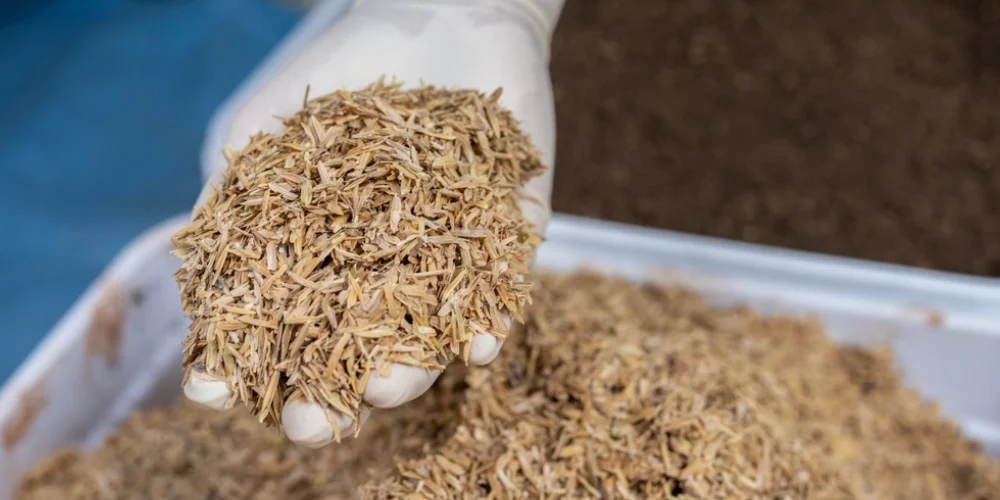
Toresyoku will use its proprietary technology to extract lignocellulose from rice husks accumulated across Minamisoma. The resulting material serves as an alternative to glass fibre reinforcement in plastics, while the silica byproduct generated during processing is processed into potassium silicate fertiliser and returned to local farms.
In the Hamadori region of Fukushima Prefecture, rice cultivation has steadily recovered following the 2011 disaster. However, processing facilities for surplus rice husks have not fully restored capacity. Rice husks present a persistent disposal challenge because their high silica content renders them resistant to natural decomposition and combustion. Simultaneously, conventional glass fibre used in plastic manufacturing carries notable environmental drawbacks, including high energy consumption during production, accelerated wear on moulding machinery, and disposal hurdles during incineration.
Toresyoku’s process removes silica from the husks to yield lignocellulose, allowing plastic manufacturers to reduce their reliance on glass fibre while maintaining necessary physical properties. To support the operation, Minamisoma City and Toresyoku are establishing a stable collection network alongside local farmers and agricultural groups. The partnership also involves collaborating with regional logistics and storage firms to build a local supply chain, alongside plans to establish research and production facilities within the city. Production will begin with small-scale prototyping before expanding operations across the Hamadori area and other rice-producing regions in Japan.
Minamisoma Mayor Kazuo Monma noted that local recovery efforts have prioritised creating new industries from regional resources, highlighting that the project provides a meaningful model for linking farming and industry, upcycling rice husks into industrial materials. Toresyoku Chief Executive Officer Satoshi Okimura stated that the company aims to create a closed regional loop by upcycling local husks into new materials and returning the byproduct to agriculture.
[Reference] Toresyoku Notice (Japanese)