 Zenbird Editorial Team
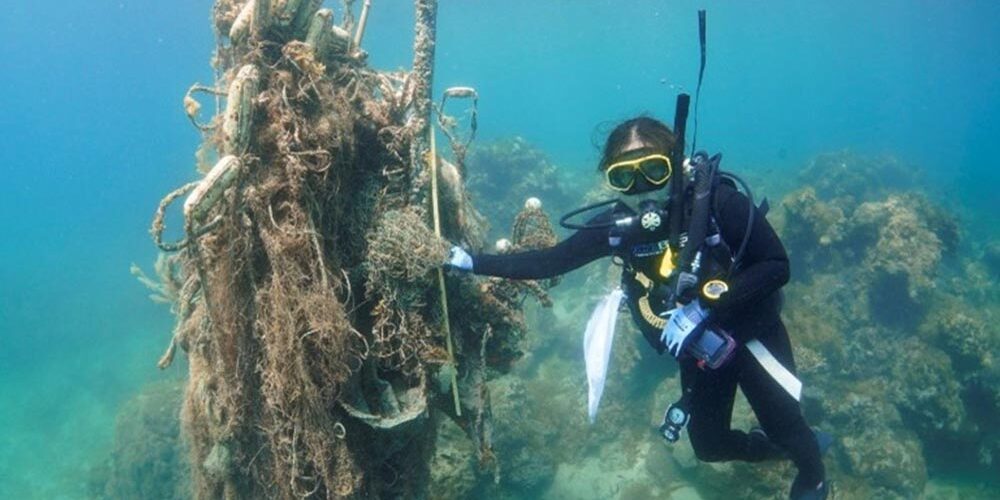
A three-metre-high mass of derelict fishing gear, known as ‘ghost gear’, was recovered from the sea near Tatara Island in Goto City, Nagasaki, last week. The operation was led by WWF Japan in collaboration with local fishers and divers, and the team removed the significant marine pollutant, which posed a threat to a nearby coral reef and maritime safety.

The recovered object was a tangled mass of fishing nets, ropes, and plastic baskets, encrusted with algae, sponges, and fragments of coral. The gear had been known to local stakeholders for several years, and was a hazard to a nearby world-class coral community, as well as to fishing areas and ship navigation. The recovery was conducted by the ‘Ghost Gear Investigation Team’, a WWF Japan project launched in July 2023. The team works with divers, fishers, and local authorities across seven locations in Japan to understand the reality of pollution from fishing-related plastics.
Yap Minlee, an officer in WWF Japan’s Oceans and Seafood Group, commented on the operation’s significance, saying, “The reality of ghost gear in Japan, previously unknown, is gradually coming into view. This operation in Goto was our first recovery of large-scale ghost gear, and it was a valuable experience. At the same time, the recovery of large, ownerless ghost gear involved more effort than imagined, including costs, labour, and stakeholder coordination. It reaffirmed the need for administrative support.”
Ghost gear is abandoned, lost, or discarded fishing equipment and accounts for approximately 10 percent of all marine plastic waste. According to a 2024 report from Japan’s Ministry of the Environment, fishing-related plastics such as gear and buoys make up 50 to 60 percent of all beached plastic litter by weight in the country. This debris continues to trap marine life in a process known as ‘ghost fishing’ and breaks down into microplastics, damaging marine ecosystems.
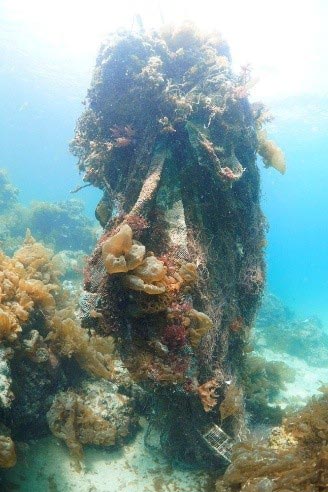
Following the recovery, the mass of gear will be cleaned and sorted for detailed analysis to better understand its composition and origin. WWF Japan intends to use the findings from all seven survey sites to advocate for wider quantitative surveys and the establishment of new policies to tackle the ghost gear problem. Once all seven surveys are complete, the investigation team will use the results to appeal to authorities about the need for more extensive quantitative research, and create a framwork to emliminate the ghost gear problem.
[Reference] WWF Japan Press Release (Japanese)[Website] WWF Japan Homepage (Japanese)