 Zenbird Editorial Team
Mitsui Fudosan Co. and the Toyota Mobility Foundation conducted a series of demonstration experiments in Tokyo’s Nihonbashi district to test walking support tools for visually impaired individuals. Held in February, the trials involved six private companies and 11 participants with visual impairments. Named the WakuWaku Project, they seek to create an inclusive urban environment where all residents can navigate safely and independently.
A significant barrier to urban mobility exist in areas with high-rise buildings, where GPS signals often become inaccurate, making it difficult for navigation tools to identify a user’s exact location or the correct timing for turns. The recent trials focused on improving positioning accuracy through a combination of AI image recognition, sensors, and collaborative technologies.
Six companies provided diverse solutions for testing. The Eye Navi app used AI to detect obstacles and traffic lights, while Ashirase utilised vibration devices in shoes to guide users. The shikAI system employed QR codes on tactile paving to provide voice guidance, and Eyeco Support connected users to remote operators for real-time assistance. Additionally, Kinjo Rubber provided universal design walking mats, and Panasonic Advanced Technology tested an autonomous navigation robot that functions similarly to a guide dog.
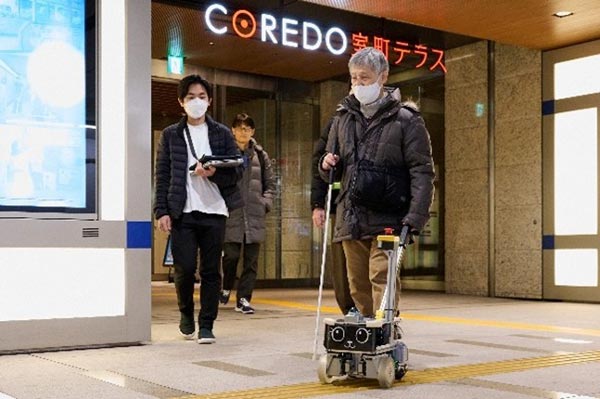
The experiments took place at several key locations, including Nihonbashi Muromachi Mitsui Tower and Coredo Muromachi Terrace. Participants navigated complex scenarios such as using elevators, walking through underground passages, and crossing busy intersections without tactile paving. This real-world setting allowed developers to evaluate how different tools could complement each other to fill gaps in current navigation technology.
Feedback from the participants highlighted the importance of intuitive user interfaces and the need for reduced mental burden during operation. The trials confirmed that combining multiple technologies, such as Visual Positioning Systems and LiDAR, significantly improves guidance accuracy in environments where satellite signals fail.
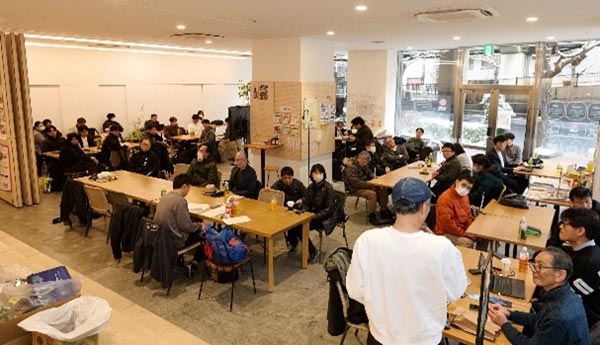
The Toyota Mobility Foundation and Mitsui Fudosan intend to use these results to accelerate the implementation of these services.
[Reference] Mitsui Fudosan Newsletter (Japanese)