 IDEAS FOR GOOD
[Kyoto Circular Economy Special Feature]
This feature series is a collaborative project between IDEAS FOR GOOD and Kyoto City, exploring the present and future of the circular economy of Kyoto. How can the spirit of “Shimatsu no kokoro,” together with circular living and a centuries-old culture of craftsmanship in Japan’s ancient capital, be harnessed to drive innovation that will shape tomorrow’s Kyoto? And how can they give rise to circular businesses that will thrive for the next thousand years? Together with Kyoto City, local businesses, and policy advisor Akihiro Yasui, we explore Kyoto’s unique value and potential through the lens of the circular economy.
Kyoto City is leveraging its history, culture, and a deep-rooted sense of “Shimatsu-no-kokoro”—a spirit of mindful frugality and respect for resources—to lead the transition to a circular economy. It aims to forge a new urban future where environment and industry are in perfect harmony.
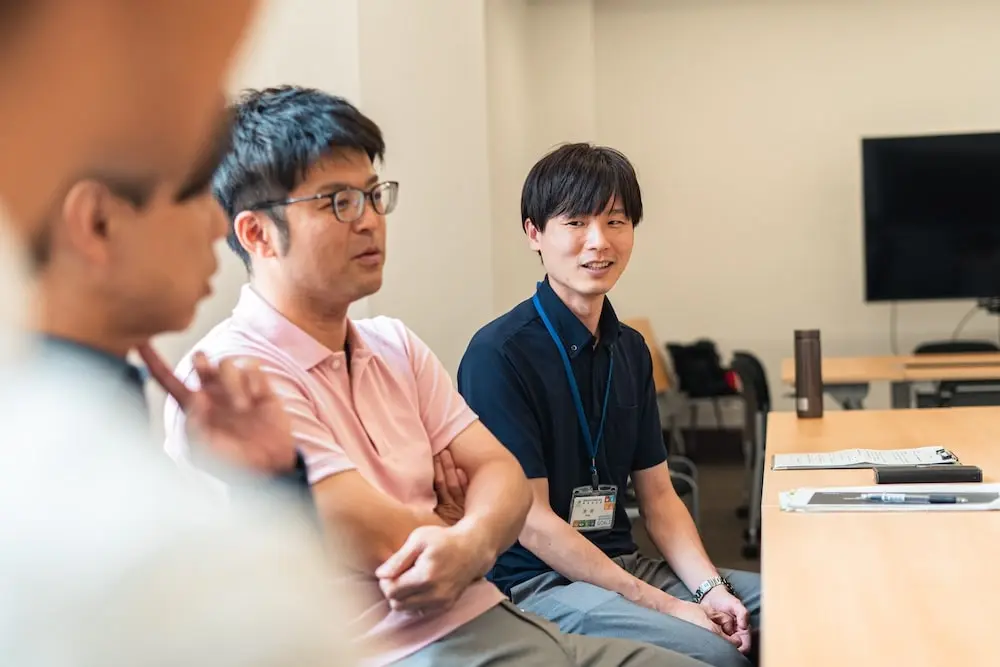
This special feature has previously explored the city’s motivation for embracing the circular economy. We then dedicated five articles to a range of circular economy initiatives throughout the city. For this final instalment, we sit down with Akihiro Yasui, a Policy Promotion Advisor for Kyoto City and author of Circular Economy Jissen (Circular Economy in Practice), Gakugei Shuppan, for a dialogue with three members of Kyoto City’s Environmental Bureau’s Circular Economy team to explore the future of a uniquely Kyoto-style circular economy.
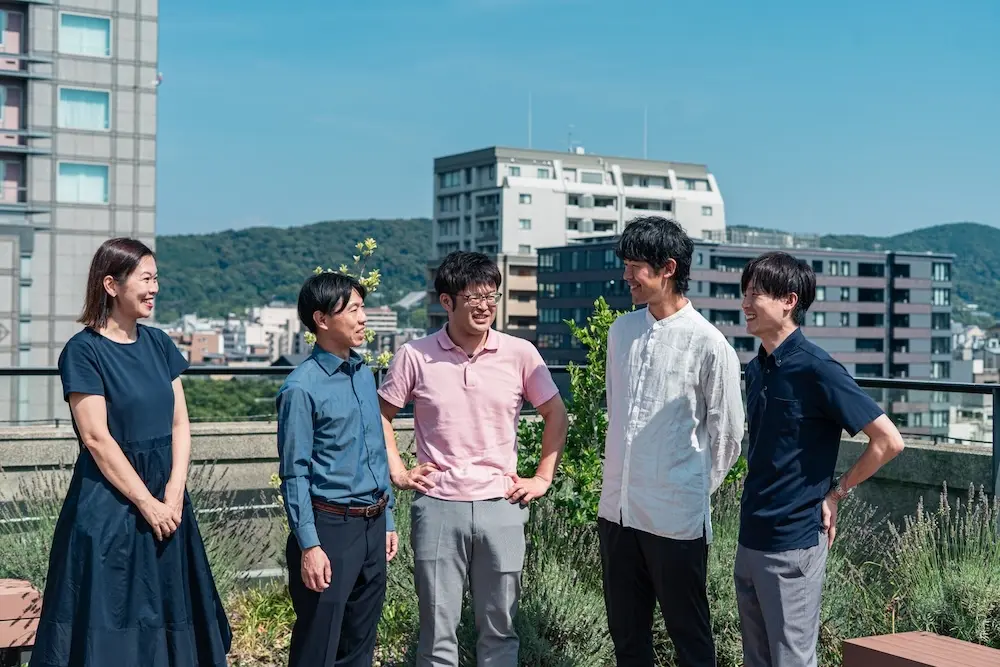
Interviewee profiles:
Akihiro Yasui
Kyoto City Policy Promotion Advisor / Author, Circular Economy Jissen (Circular Economy in Practice)
Masanori Kimura
Director, General Affairs Section, Planning and General Affairs Department, Environmental Bureau, Kyoto City
Taro Sakurai
Assistant Director, General Affairs Section, Planning and General Affairs Department, Environmental Bureau, Kyoto City
Tomohiro Ikeda
Staff, General Affairs Section, Planning and General Affairs Department, Environmental Bureau, Kyoto City
Connecting Kyoto’s urban fabric, well-being, and circularity
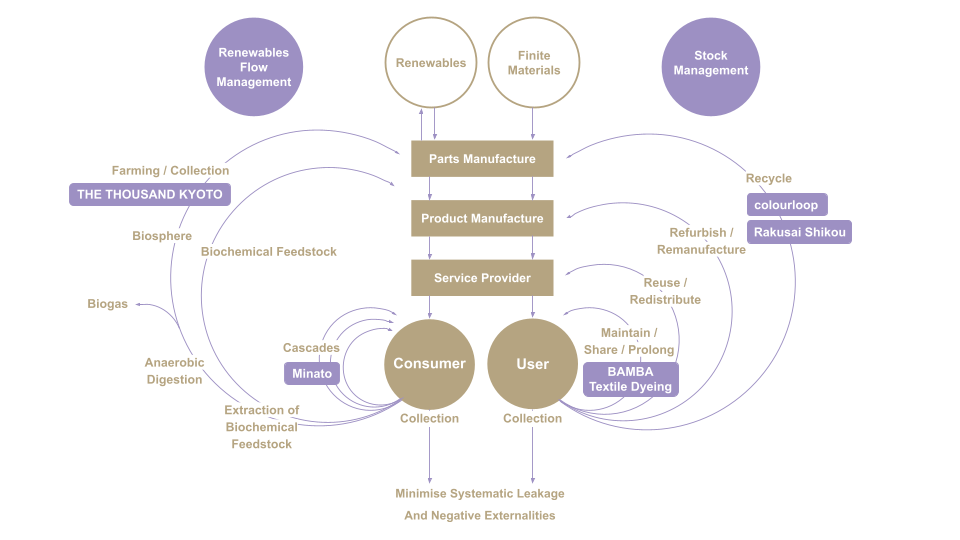
Throughout this series, we have profiled five businesses in Kyoto: Minato, BAMBA Textile Dyeing, colourloop, Rakusai Shikou, and THE THOUSAND KYOTO. We examined how these businesses are embodying circular economy practices across industries that are emblematic of Kyoto—traditional crafts, manufacturing, textiles, food, and tourism. In response to these examples, what common threads did Yasui and the Kyoto City team identify?
Yasui: “I have lived in Kyoto for four years and have worked on the circular economy with many local companies and residents. My honest impression is that there are still so many initiatives I don’t know about, and it’s a testament to Kyoto’s potential. The dedication of everyone involved and the initiatives that go beyond simple recycling and upcycling are truly fantastic and essential.”
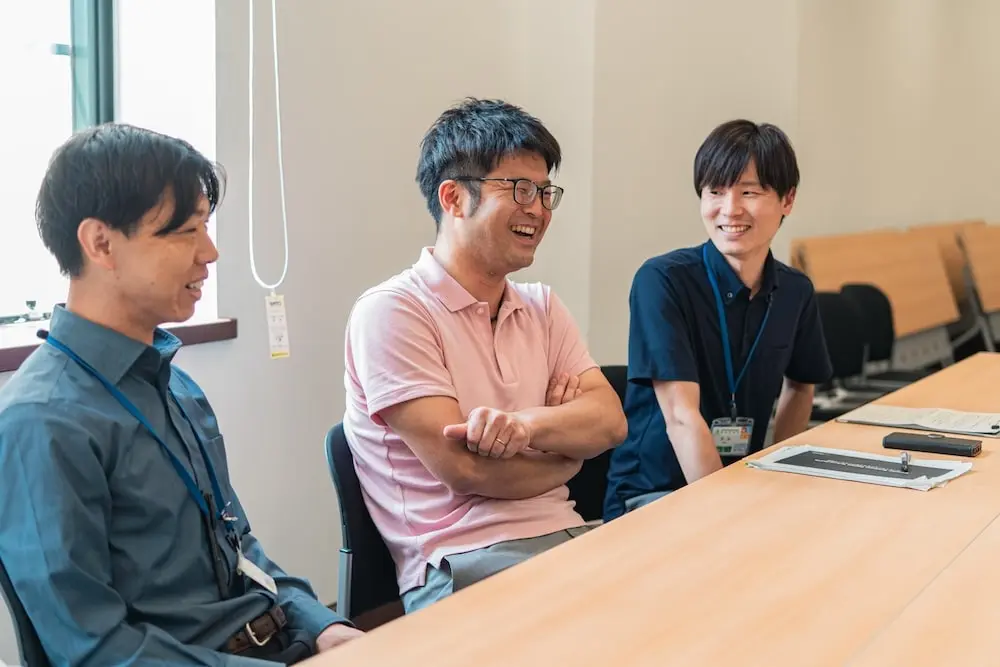
Kimura: “Despite the differences in fields and industries, what they value is the same. It’s not about self-interest but about cherishing the people and the city of Kyoto. I feel that the tradition of grassroots self-governance and the spirit of mutual support are naturally ingrained here. I also found it a new discovery that, after facing various hardships, they commonly encountered circular economy thinking as an opportunity to turn a crisis into a positive. While it may be a coincidence, I was reminded that this mindset is a catalyst for moving forward from difficult situations and a hint for new growth.”
Sakurai: “My impression was that many people are mindful of their suppliers and customers. This reminded me of the concept of ‘well-being,’ which has gained a lot of attention in recent years. I once read a book that hypothesised that while well-being in Europe and North America is an ‘acquisitive’ feeling, the Japanese are more comfortable with a ‘collaborative’ sense of happiness. I understood this to mean, ‘I feel good because everyone else is doing well,’ and I feel that those practising a circular economy are naturally acting with this mindset. I believe the circular economy is an action for society. Well-being is defined as a virtuous cycle where social behaviour and social capital mutually enhance one another. Therefore, I feel that the circular economy is highly compatible with well-being and is a key component for achieving it.”
Does the inability to expand a city foster circularity?
As mentioned in the first article of this series, Kyoto City has a deep-rooted “Shimatsu-no-kokoro.” It was a pioneer in implementing a paid rubbish bag system, charging for plastic bags, and setting food waste reduction targets, leading to a 50% reduction in waste over approximately 20 years since 2000. It is now known as a leading municipality in the environmental sector, boasting one of the lowest per capita waste discharge rates among designated cities.
Furthermore, numerous circular economy initiatives are taking place across the city—from food and manufacturing to tourism and events—making it common to see Kyoto-born examples. Given these facts, can we already call Kyoto a leading city in the circular economy? And if so, why? Yasui explained Kyoto’s unique characteristics from three perspectives: its citizens, businesses, and urban structure.
Yasui: “Personally, I don’t believe any one city is ahead of the others in the circular economy. People often ask me if the Netherlands, where I used to live, is ‘ahead,’ but I don’t always feel that’s the case. Instead, I believe it’s more important for each country and region to have its own excellent initiatives and features and to share what they have with others. This way, we all move forward together. That said, I’ve certainly noticed that many people who move to Kyoto become interested in the circular economy. When I’ve thought about why, one reason is that many residents live here because they love Kyoto.
When you love Kyoto and live or run a business here, you naturally gravitate towards lifestyles and business practices that are not just economically rational but also distinctly ‘Kyoto.’ This might be highly compatible with the circular economy mindset, which focuses on utilising unused resources and prioritising well-being.”
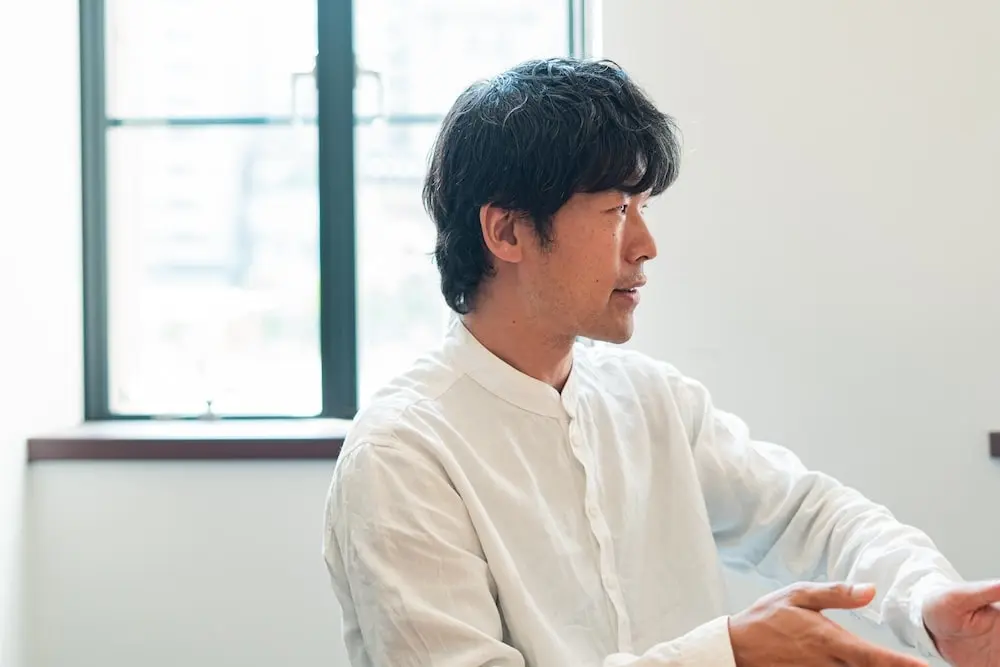
Yasui: “Learning from long-established businesses is also significant. Before moving to Kyoto, I had a conservative impression of these heritage businesses, but that was not the reality. I have learned from many companies that to last for a long time, you must remain innovative. They prioritise how to pass on the business to the next generation in the medium to long term, rather than focusing on short-term expansion or economic growth.”
Japan has the largest number of long-established companies in the world. Of the approximately 75,000 companies globally that have been in business for over 100 years, 45,284 are Japanese (which is more than half). Of these, Kyoto Prefecture has the highest concentration at 1,897. Why do Kyoto’s businesses have such a long history? The answer may hold a clue to sustainable circular business models.
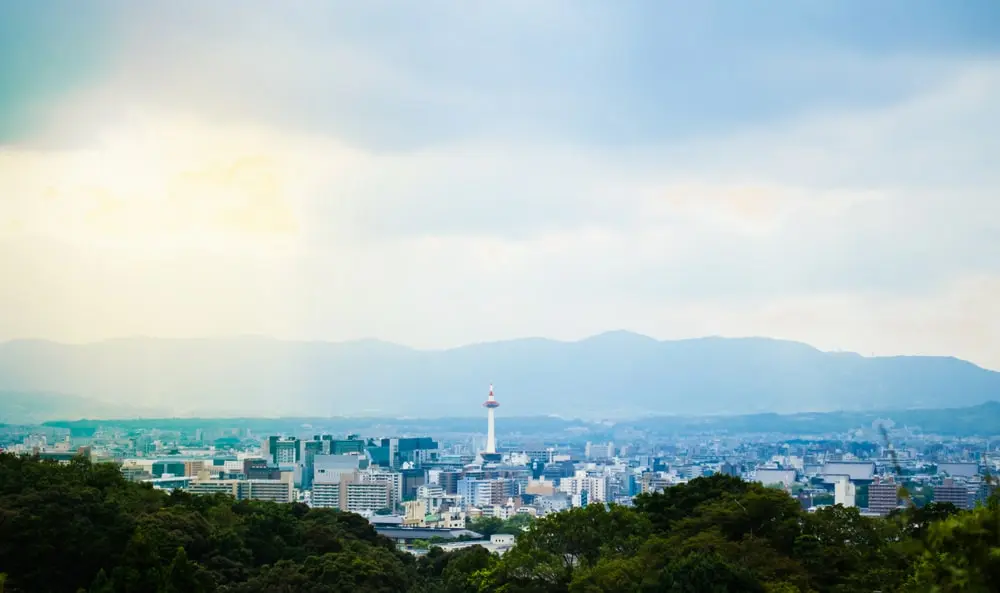
Yasui: “I also believe that physical constraints play a big role. Due to building height restrictions in Kyoto City, vertical expansion is not an option. Also, because the city is surrounded by mountains, it cannot expand horizontally. When faced with these limitations, people’s attention naturally shifts from physical expansion to how to maintain well-being and business within the existing space.”
Kyoto is a city where physical expansion—both upwards and outwards—is challenging, and its urban area is in close proximity to nature. Perhaps this is why, within its limited land and resources, the pursuit of added value has led to the cultivation of “Shimatsu-no-kokoro,” along with a spirit of care for nature and others, and a tradition of grassroots self-governance. As a result, people, nature, resources, and mutual care have all circulated, seamlessly connecting tradition and culture to the present day.
The same is true for the Earth. Humans cannot live by exceeding the limits of the Earth’s ecosystem, known as the planetary boundaries. To achieve the well-being of 8 billion people within the constraints of limited resources, we need a spirit of mutual support rather than competition, and a “Shimatsu-no-kokoro” to leave the Earth clean for future generations. Yasui’s insights can be directly translated into a message for the entire world.
“Preservation by innovation”: A four-way-win circular economy
The unique characteristics of Kyoto’s land and the culture that has flourished there have created fertile ground for the circular economy. So, what does a future-facing, Kyoto-style circular economy look like, shaped by its history and nature? Sakurai analysed Kyoto’s uniqueness from the perspective of economic supply and demand.
Sakurai: “I’ve lived in Kyoto for about 15 years, and here is what I’ve observed. From a supply perspective, Kyoto has a history of developing its industries by pursuing high-value-added manufacturing. From a demand perspective, I once asked a friend whose family has lived in Kyoto for generations why she takes such good care of things, and she told me, ‘My grandmother always told me to take care of my things.’ I felt that the culture of ‘Shimatsu-no-kokoro’ was being passed down. From both the supply and demand sides, I feel that Kyoto has a deeply rooted culture that is receptive to circular thinking and consumption patterns.”
Kimura added that Kyoto is not only adept at honouring tradition but also at creating a new future.
Kimura: “It may seem surprising, but Kyoto is said to be a place that readily accepts new and diverse things. The city has a wide variety of businesses, from long-established ones that carry on tradition to venture companies and globally renowned large corporations. What many of these companies have in common is that they don’t just protect their traditions and culture; they also have a pioneering and enterprising spirit that has allowed them to flexibly adopt new things, which is said to have led to innovation and continuity for the next generation. I feel this reflects Kyoto’s unique character, where diverse people involved with the city show care, acknowledge one another, and warmly welcome those who also love Kyoto.”
As Yasui recalled from his own learning from heritage businesses, “Preservation by Innovation” might be the distinctly Kyoto way of creating a sustainable, circular future. When viewed through the lens of circularity, the metabolism between conservation and innovation becomes clear, revealing a natural approach to a Kyoto-style circular economy.
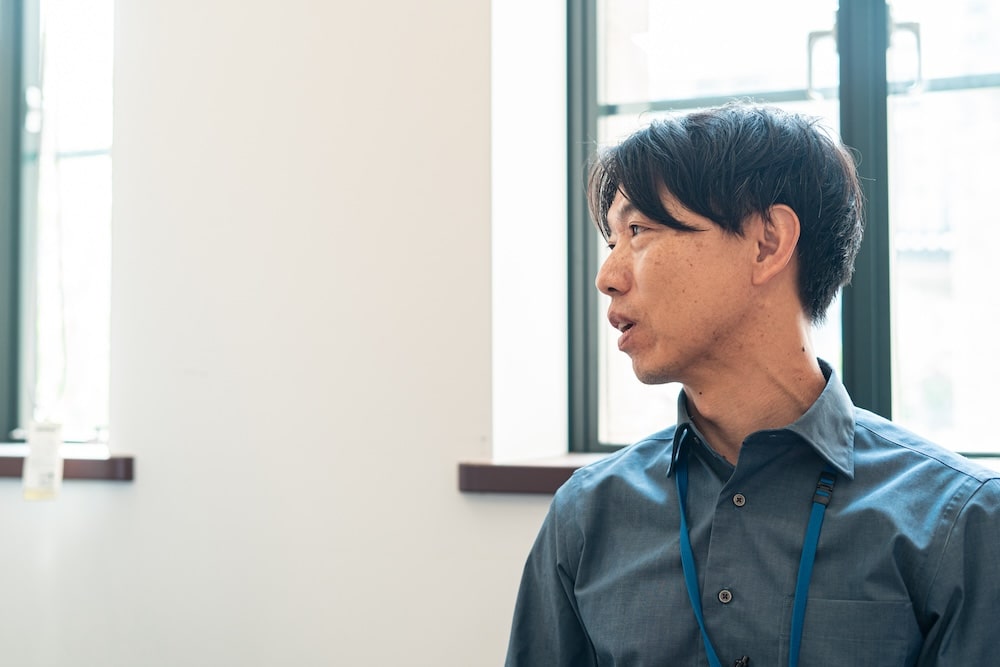
Kimura: “Another uniquely Kyoto characteristic, I believe, is that basic things, like taking care of objects, are done naturally and are deeply rooted in people’s lives. I think the initiatives that residents and businesspeople have undertaken were inherently circular to begin with. The Kyoto-style circular economy is about reinterpreting these actions and updating them by incorporating new concepts, cultures, and technologies.”
Sakurai: “The philosophy of the Omi merchants, ‘sanpo-yoshi’ (good for the seller, good for the buyer, and good for society), has been expanded to a ‘four-way win’ by adding ‘good for the future.’ This idea may also be a good hint. It’s a philosophy where businesses, citizens, and society as a whole all benefit, and the future also benefits.”
Ikeda: “The ‘medium-to-long-term’ perspective that Yasui mentioned is also very important. All the businesspeople we interviewed were creating their businesses with a view to what kind of society they want for the children and the next generation. I believe that is what connects them to the circular economy.”
Yasui: “I was impressed by how all the interviewees carefully reflected on their company’s past, spoke in detail about the founding philosophy and how the business has changed with the times, and from there, meticulously wove a story for the future. When a business is passed on, I feel they are not just inheriting the company and its funds, but also its unique character and core concept. It is only by carefully unravelling the past that they can meticulously weave the future.”
A “conjunction” that transforms business problems and waste into collaboration
To realise a truly Kyoto-style circular economy, the city will launch a new learning programme in autumn 2025, the Circular Business Design School Kyoto. We asked the team what they hoped the programme would achieve.
Yasui: “Historically, companies have tended to hide their problems, waste, and difficulties. However, in a circular economy, these problems can become ‘conjunctions,’ creating the potential for innovation that leads to new business and collaborations with other companies. By coming to this programme, your own experiences might be unexpectedly valuable. I want everyone to participate with a ‘learning by doing’ mindset, where it doesn’t have to be perfect, but we find a balance as we go along.”
Kimura: “The phrase ‘learning by doing’ that I learned from Yasui is truly excellent. It resonates with the mindset of the businesspeople we interviewed, and I personally hope it spreads not only in the circular economy sector but also in the workplace and society as a whole. In an age of uncertainty, I hope we can continue with a mindset of making adjustments as we go.”
Sakurai: “I hope to involve people from a wide range of industries in this programme, with the circular economy as the keyword. Even if they don’t participate in the programme, there are various entry points, such as becoming a partner or attending networking events. You never know where a good collaboration might emerge, so we want to appeal to as broad an audience as possible.”
Ikeda: “By participating, you may gain unexpected insights and connections. I really hope many people will join.”
Editorial note
After the interview, walking through the streets of Kyoto, the scenery looked a little different. We are often drawn to the term “circular economy” and tend to look for clues for its realisation in far-off examples. However, this dialogue taught us that the true essence of the circular economy has been deeply rooted in the soil of Kyoto for 1,200 years.
The “problems” and “waste” that arise in our daily business operations are often treated as “costs” or “challenges.” But what if they could become “conjunctions” that connect us with others to create new value? They could be a bridge connecting objects and people, and the past and the future.
The learning programme about to begin in Kyoto City is not just a study session. It is a testing ground and a place for dialogue where businesses that have never met before can bring their challenges, use them as “conjunctions,” and create new innovations together. It is a space for co-creating the future.
The next 1,000 years of Kyoto—and of Japan—will be built by us, the people living today. By bringing our challenges instead of our strengths, helping instead of competing, and protecting the future through innovation. If you want to move together towards a uniquely Kyoto-style circular economy, why not knock on its door?
[Launching October 2025] Circular Business Design School Kyoto
Kyoto is home to timeless assets nurtured over 1,200 years: the spirit of “Shimatsu no Kokoro”, circular ways of living, and a culture of craftsmanship. We are facing urgent global challenges such as climate change and biodiversity loss. To create a truly circular future requires drawing upon this wisdom, applying it to the present, and carrying it forward into the future. To this end, Harch Inc., which operates IDEAS FOR GOOD, will launch a new learning program in October 2025. By combining Kyoto’s deeply rooted circular wisdom with cutting-edge insights into the circular economy, the program seeks to envision and achieve the future we aspire to. “Decode Culture, Design Future”──a circular future rooted in tradition, from Kyoto.
Official website: https://cbdskyoto.jp/
Photo by Asuka Sasaki
Original article written by Yu Kato, published on IDEAS FOR GOOD.
Translated by Zenbird Editorial Team