 Zenbird Editorial Team
Last week, Japan’s Cabinet approved the 2025 Environment, Circular Economy and Biodiversity White Papers, combining three statutory reports into a single volume. Its contents urge an overhaul of production and consumption to keep future growth within planetary limits. Driven by the Sixth Basic Environment Plan, the document argues that climate change, biodiversity loss and pollution are converging into a “triple planetary crisis” and that only a net-zero, circular and nature-positive economy can safeguard the well-being of present and future generations.
The paper’s central theme is the construction of a green economic system able to deliver what officials call “new growth”. It links recent weather-related losses in Japan and abroad with rising investor pressure for carbon disclosure, showing how sustainable finance, mandatory reporting and resource efficiency can steer capital toward low-emission technologies. The government positions decarbonisation as an industrial strategy by mapping the economic stakes alongside environmental risks.
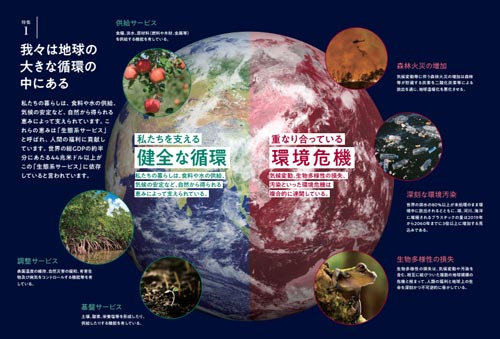
The white paper is divided into chapters that explains the interdependence of policies that reduce emissions, restore ecosystems and eliminate waste. It highlights the need to integrate circular-economy tools, including product-as-a-service models and high-value recycling, with nature regeneration and carbon neutrality. Case studies of “regional circular and ecological spheres” demonstrate how local renewable energy, resource recovery and community services can strengthen rural economies while reducing environmental footprints. The report also reviews progress in restoring areas hit by the 2011 Great East Japan Earthquake, the Fukushima nuclear accident and the January 2024 Noto Peninsula earthquake, noting a shift from clean-up to long-term resilience planning.
Putting additional efforts into creating a circular economy in Japan
Japan wants circularity as a key part of economic and environmental policy so resources can circulate efficiently within its economy. It will tighten the link between manufacturers and recyclers, develop digital traceability systems, and deploy a mix of regulation, incentives and government procurement to encourage action even when short-term profits are unclear. Concrete 2030 targets include doubling recycled plastic use, halving food loss, replacing 10 percent of aviation fuel with sustainable alternatives, and expanding e-scrap and metal recycling.
The government also aims to grow circular-economy business to at least ¥80 trillion. Locally tailored systems will handle food waste, biomass, timber, textiles and nappies, while “Circular Economy Ports,” decentralised collection stations and pay-as-you-throw fees will create local loops that create jobs and revitalise ageing communities. Investment in advanced dismantling, sorting and robotics, along with nationwide human-resource programmes and ESG disclosure, is designed to make the sector both resilient and attractive to capital.
Internationally, Japan intends to lead rulemaking at the G7, G20, OECD and UN, pushing for a Global Circular Protocol that standardises corporate reporting. It will build safe international loops for critical minerals and e-scrap, strengthen enforcement against illegal waste trade, and partner with ASEAN on legislation, monitoring and capacity building. Packages combining policy support, technology transfer and training will export Japanese waste-management expertise to the Global South, while new projects in Asia and Africa aim to cut methane from landfills and speed circular transitions. Japan sees circular businesses as a core driver of growth.
Protecting Japan’s biodiversity in face of the climate crisis
Japan’s biodiversity strategy centres on conservation in every sector of society while meeting international targets such as 30 by 30. Authorities are expanding and better managing National Parks, Ramsar wetlands and World Heritage sites, linking core habitats with ecological corridors from forests to seas and certifying privately managed “Nature Symbiosis Sites” as OECMs. A Nature-Positive Economic Transition Strategy aligns business disclosure with the TNFD, pilots biodiversity-credit markets and guides consumers towards eco-friendly choices. Local governments receive technical help to craft science-based biodiversity plans, and children’s nature programmes, sustainable tourism and revitalised visitor facilities aim to deepen public engagement.
Furthermore, Japan is promoting long-term restoration of rivers, wetlands, tidal flats, satoyama and forests, curbs invasive species and halves deer and boar numbers to protect ecosystems. The Green Food System Strategy drives cuts in farm emissions and agro-chemicals, expands organic farming and introduces cross-compliance for subsidies, while ecotourism and fair access-and-benefit sharing for genetic resources bolster rural economies. Marine measures widen protected areas and balance fisheries, seabed mining and renewables with conservation. Robust data collection, AI-assisted vegetation mapping and the forthcoming fourth Japan Biodiversity Outlook will lead evidence-based policy, and Japan channels expertise and funding into regional and global partnerships to help deliver the Kunming-Montreal Global Biodiversity Framework.
A forward looking report
The release of the white papers signals to global brands sourcing from Japan that tougher expectations on supply-chain transparency, recycled content and biodiversity safeguards are imminent. Designers, entrepreneurs and local governments are encouraged to use the policy framework to scale refill schemes, sharing services and nature-positive tourism. There will also be sessions to dive deeper into the findings beginning nationwide on 13 June, and an English-language edition is planned for the autumn to aid international investors, researchers and civil-society groups.
[Reference] Japan Ministry of the Environment Announcement (Japanese)[Reference] 2025 Environment, Circular Economy and Biodiversity White Papers Page (Japanese)
[Reference] Sixth Basic Environment Plan