
 Zenbird Editorial Team
Harch Inc., a media and sustainability support company based in Tokyo, has announced the development of the “Circular City Transition Indicator” and the release of a corresponding dashboard covering over 1,700 municipalities across Japan. This platform was developed in collaboration with Sumitomo Mitsui Trust Bank, and aims to accelerate the transition toward regional circular societies by providing local governments with a tool to visualise and assess their progress.
The Circular Economy movement has gained traction as a national strategy in Japan to achieve sustainable growth amidst environmental and resource constraints. Within this framework, regional circulation and revitalisation are critical themes. For a sustainable society to materialise, local governments must take the initiative to implement strategies tailored to their specific regional characteristics while co-creating solutions with diverse stakeholders from the public, private, and academic sectors.
This release follows the “Circular City Transition Guide” published by Harch in October 2024, which served as practical guidance for municipalities aiming to transform into circular cities. The newly released indicators represent an evolution of that effort. The project utilises Generative AI to collect, organise, and visualise data for all municipalities in the country.
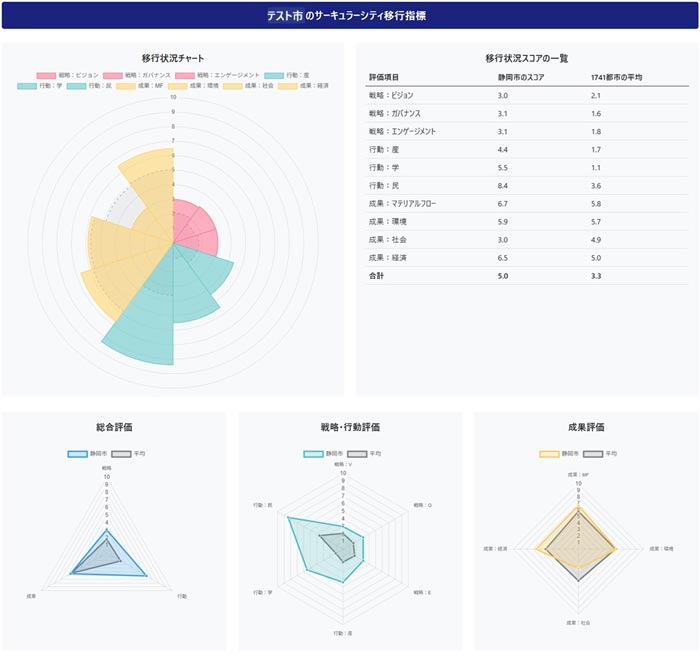
A distinct feature of this dashboard is its comprehensive approach to data. In addition to traditional systematised metrics such as recycling rates and regional economic circulation rates, the system incorporates previously non-systematised data. This includes the existence of specific strategies and the status of local activities. The dashboard allows initiatives undertaken by municipalities to be reflected in the indicators over a short period, enabling local governments to operate PDCA (Plan-Do-Check-Act) cycles more rapidly and effectively.
The indicator framework consists of three categories: Strategy, Action, and Impact. “Strategy” measures the promotion status of circular city policies by the local government. “Action” tracks the activity status of major stakeholders within the region regarding the circular economy. “Impact” assesses the outcomes generated within the region as a result of these strategies and activities.
Harch shared that the dashboard is not intended to rank municipalities against one another. Instead, the objective is to allow local governments to grasp their current status objectively and quantitatively, thereby connecting these insights to subsequent actions.
The dashboard has been released as a Proof of Concept (PoC). Harch intends to update the indicator system to make it more effective for a wide range of stakeholders by continuing discussions with various municipalities, companies, and administrative agencies. The dashboard is currently available for viewing online.
By visualising the often invisible elements of policy and community engagement, this tool addresses a significant gap in how local sustainability is measured. It moves the conversation beyond simple waste management statistics to a more holistic view of how Japanese regions are integrating circularity into their governance and community fabric.
[Reference] Harch Inc. News (Japanese)[Reference] Circular Economy Hub (Japanese)
[Reference] Circular City Transition Indicator (Japanese)
[Related Article] Mitsui Sumitomo Trust Bank, Harch release Circular City Transition Guide