Zenbird Editorial Team
Daiei Kankyo has commenced demonstration tests of a pioneering unmanned sorting plant for small electronic waste, a move set to advance the recovery of precious and rare metals while improving safety in the recycling sector.
The new facility, located at the Daiei Kankyo’s DINS Kansai site in Sakai City, houses the CEDEST system. This comprehensive sorting system was developed to tackle challenges in the recycling industry. Since Japan’s Act on Promotion of Recycling of Small Waste Electrical and Electronic Equipment was enacted in 2013, the variety of collected devices has grown, and the risk of fires from lithium-ion batteries has increased the burden on manual sorting operations. This becomes a bottleneck for efficient resource circulation.
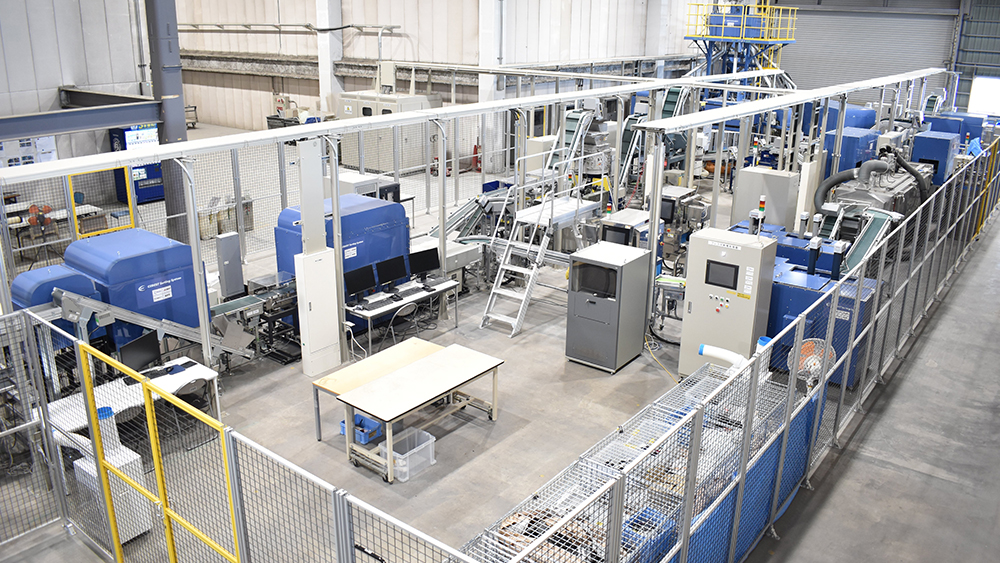
Developed by the National Institute of Advanced Industrial Science and Technology (AIST) as part of a New Energy and Industrial Technology Development Organization (NEDO) project, the CEDEST system fully automates the sorting process. It targets six product categories: smartphones, tablets, feature phones, digital cameras, video cameras and small games consoles. An AI-powered Product Sorter first identifies each device from a database of approximately 2,000 models before sending it to the appropriate disassembly line.
The system’s ability to safely handle volatile lithium-ion batteries is a key strength. Devices like smartphones are sent to a Battery Disassembly System, which uses X-ray imaging to locate the battery and cut open the casing without damaging it. The components are then separated using a controlled cooling and impact process. Other devices are processed by a specialised shredder that disassembles them without causing batteries to ignite.
Subsequent stages involve a Module Sorter that separates components like circuit boards, batteries and casings. The circuit boards are processed by a Board Stripping Machine that removes electronic components while keeping them intact. Finally, a Transformable Sorting System uses a calculated, optimal sequence of processes like magnetic and gravity separation to recover high-purity streams of materials, including copper, gold-containing IC chips and tantalum capacitors.
Daiei Kankyo will now conduct continuous operational tests to evaluate the system’s performance and viability for unmanned operation. The company states that the CEDEST system is the world’s first unmanned, comprehensive sorting system for advanced recycling. Future research and development will focus on expanding the range of compatible products and recoverable materials.
[Reference] Daiei Kankyo Press Release (Japanese)